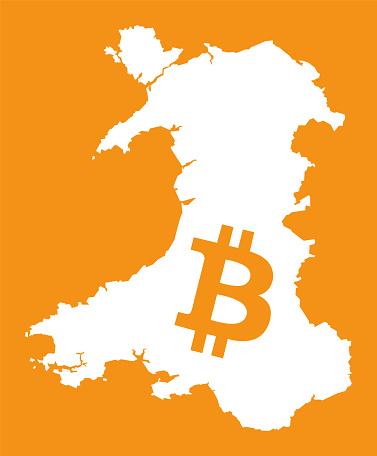
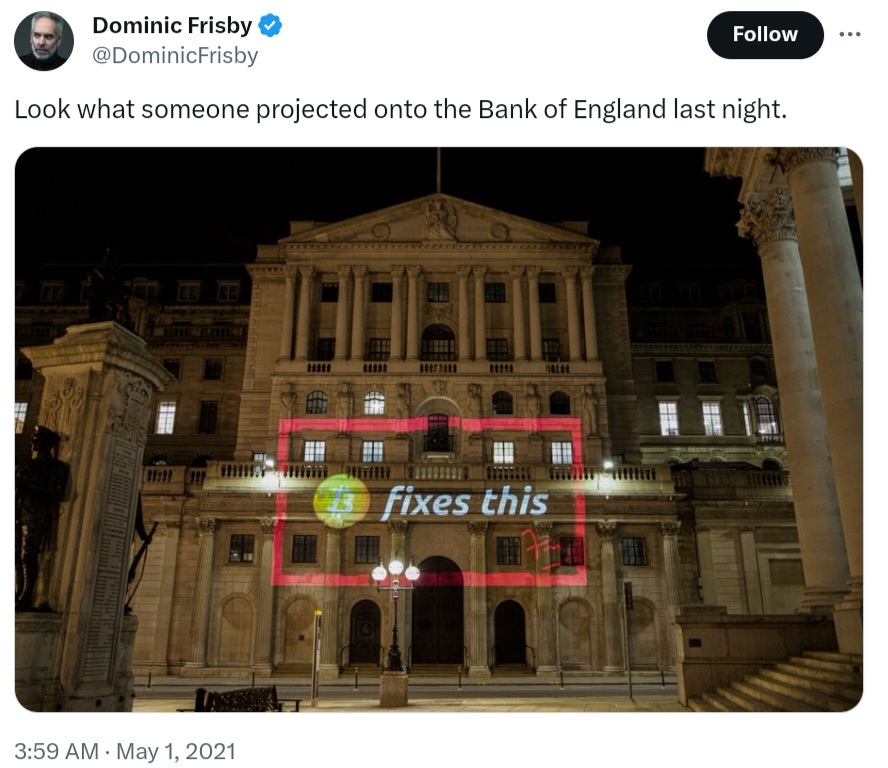
In the depths of the Covid Pandemic, the decentralised future illuminates upon the Bank of England, the foundation of the Union through the British Pound since 1694 (source)
Introduction
Part One of the essay will deal with the Past, the history of Wales as an independent Nation from Roman roots, the evolution through the Middle Ages and Gwynedd’s supremacy over the rest of Wales, up to the Acts of Union with England in 1535 and 1542 under the reign of Henry VIII, bringing to an end the Catholic and Feudal order as Wales suffers its Protestant Reformation and the multi century process of Anglicising and Britainisation of the Welsh. The essay will discuss the all important role of the British Pound, particularly since the founding of the Bank of England, imprisoning the peoples of Britain in a common Currency and Customs Union, and a monumental subsidy to enrich London and the South East of England at the expense of impoverishing the North and Midlands of England, Scotland and Wales.
PART ONE: PAST
History of Wales as a Nation
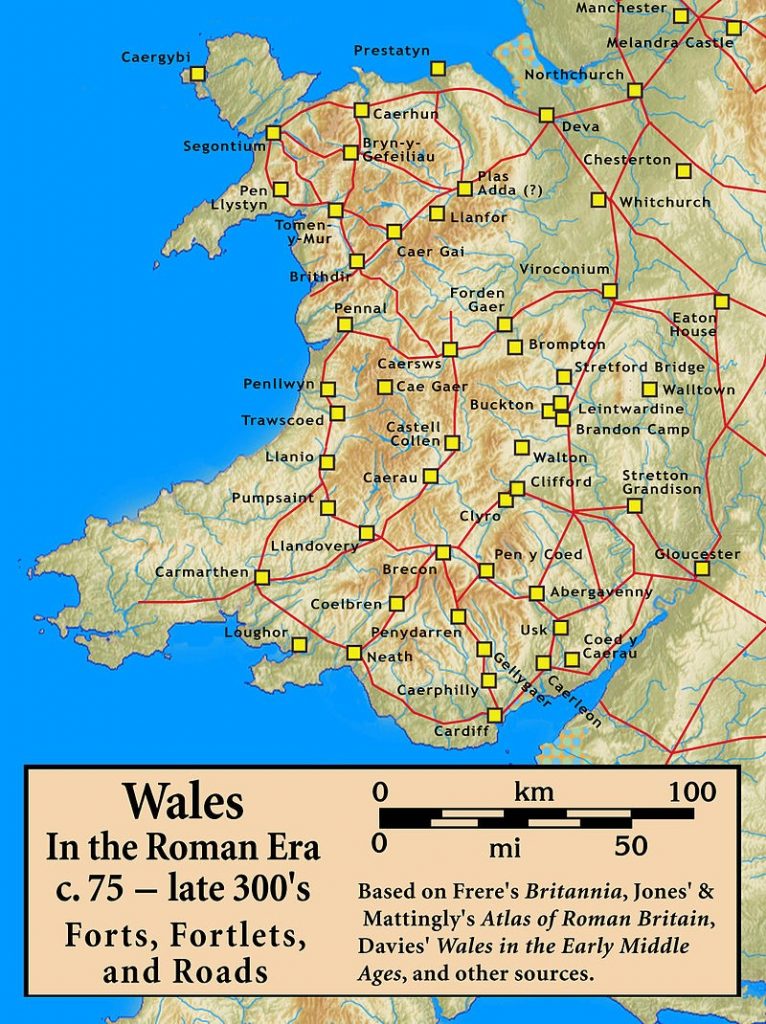
Roman Wales at the end of the Fourth Century (source)
While archaelogical evidence of people in Wales originates around 9,000 year ago, the history of Wales as a Nation is inextricably linked to the Romans following the conquering of Wales in 43 BC, in the reign of Julius Caesar. The Romans remain in Wales and Britain for over three Centuries and until the Year 383, when the slow motion demolition of the Empire on the Continent leads to their gradual withdrawal.
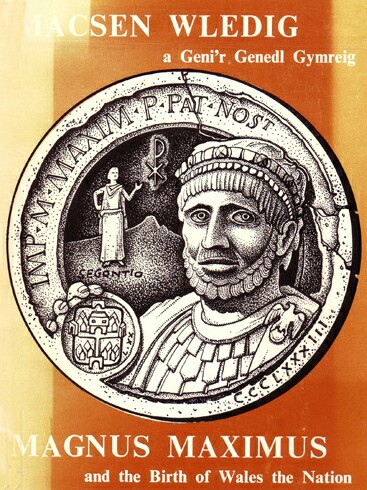
The Dream of Macsen Wledig Legend (source)
The establishment of Wales as a Nation is linked to the legend and mythology of the real life Magnus Maximus, the late stage Western Roman Emperor between 383 and 388, and the families of the Kings and Princes of Wales during the Middle Ages claim these Roman roots and lineage.
The Early Middle Ages (5th to 10th Century)
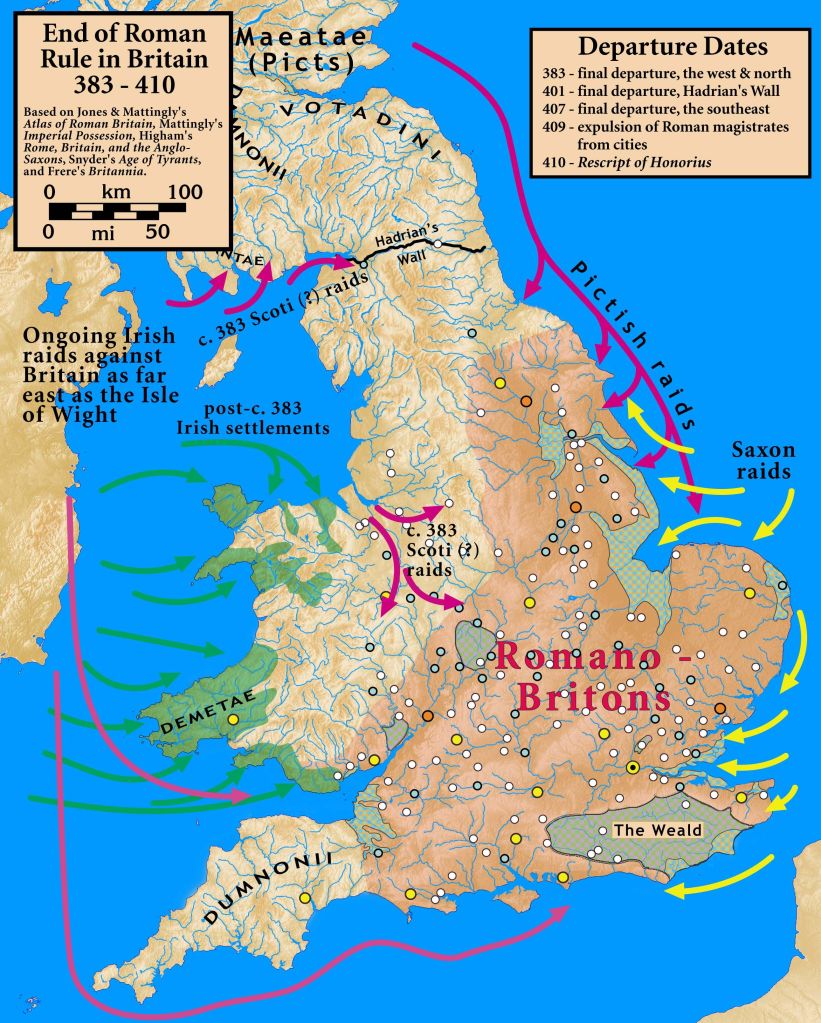
The decentralisation of the British Isles following Roman Departure (source)
Rome finally departs in the Year 410, leaving numerous regions controlling themselves distributing centralised power. Under the Romans the Welsh are already connected to Christianity, and the Age of the Saints lasts nearly three centuries from 400 AD to 700 AD, establishing churches and monasteries throughout Wales, through pioneers in Saint David, Illtud and Teilo.
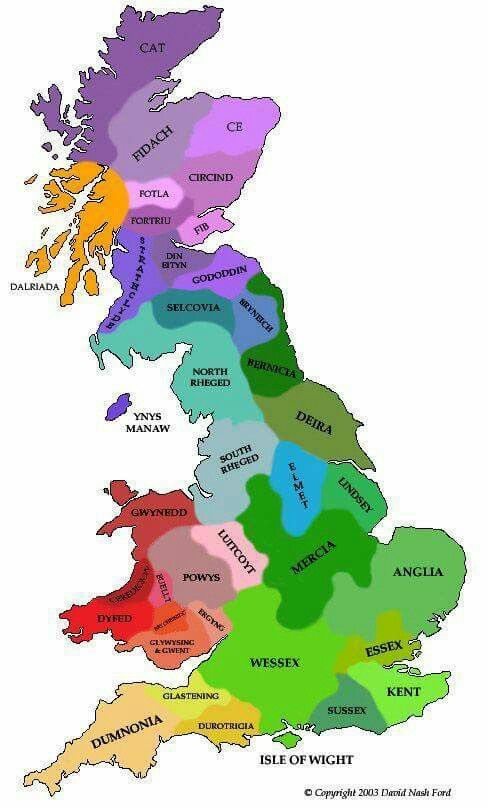
The British Isles of the Seventh Century (source)
Roman departure encourages the Continental Saxons to invade and settle in the South East of England, and the Angles in the North East, over the Seventh Century the Britons lose the territory of England, and the Brythonic disconnection of Wales, Cornwall and the Old North.
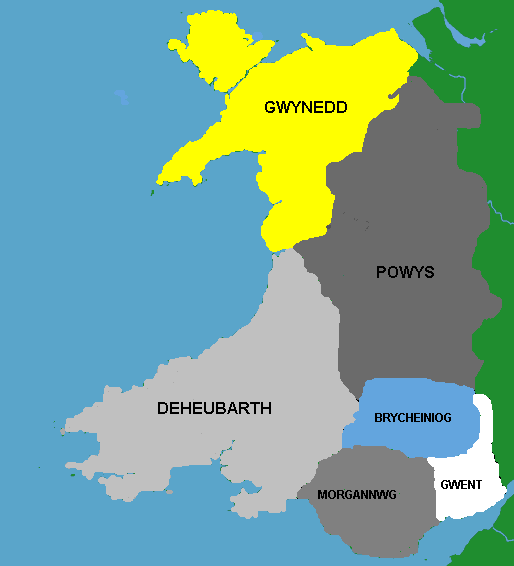
Early Welsh Kingdoms (source)
Within Wales there is a distribution of Kingdoms, the largest being Gwynedd in the North West and Powys in the East, because of the geography of Powys on the border with Mercia and their defensive battling against the English, ensures the supremacy of Gwynedd as the strongest Kingdom by the 8th Century. Despite Gwynedd’s fortitude, it is very difficult to unify Wales during this period because of the nature of Celtic Law that divided property and kingdoms between all sons, rather than Anglo-Saxon Law and the usual inheritance by the eldest son. The result is advantageous for the distribution of powers within Wales, but also at a disadvantage in weakening Wales as a defensive force against an united and more centrally controlled England.
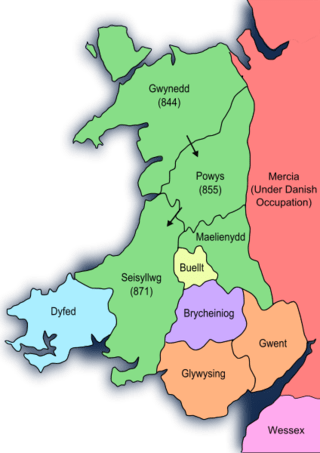
Gwynedd expands under the reign of Rhodri the Great (source)
The Ninth Century sees the rise of Rhodri the Great King of Gwynedd, who also comes to rule Powys and Ceredigion. His Grandson, Hywel Dda (Howell the Good) would create the Kingdom of Deheubarth and standardise Welsh Law, aka The Laws of Hywel, and negotiates peace with England. After the death of Hywel in 949, Gwynedd breaks away from the Kingdom.
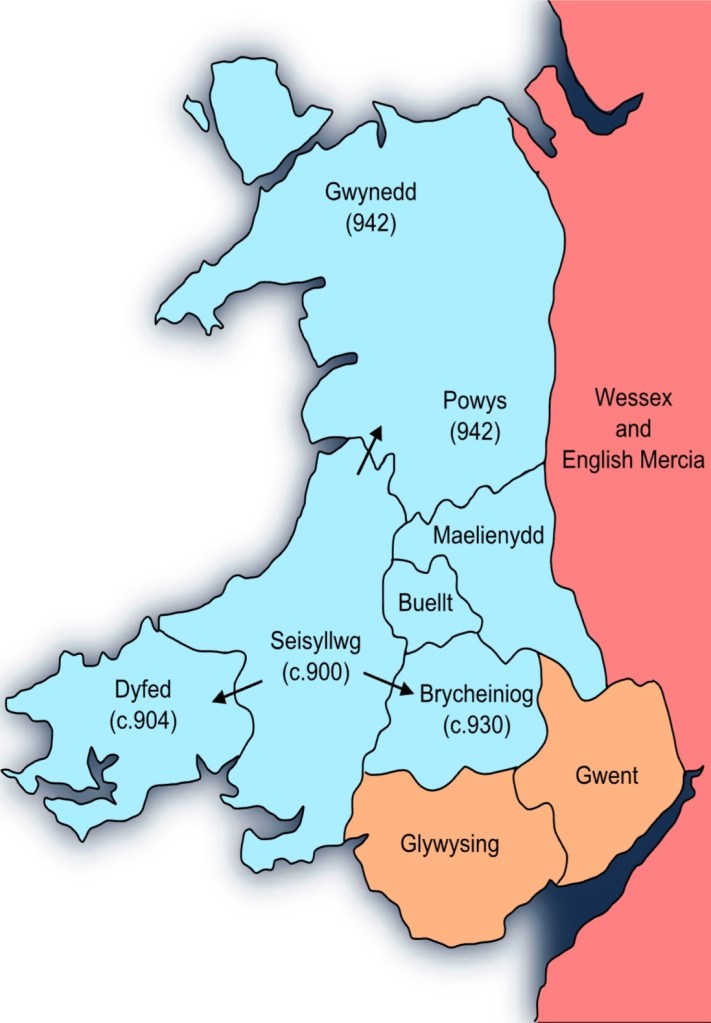
Wales is nearly unified under the reign of Hywel Dda (Source)
Late Middle Ages (11th to 15th Centuries)
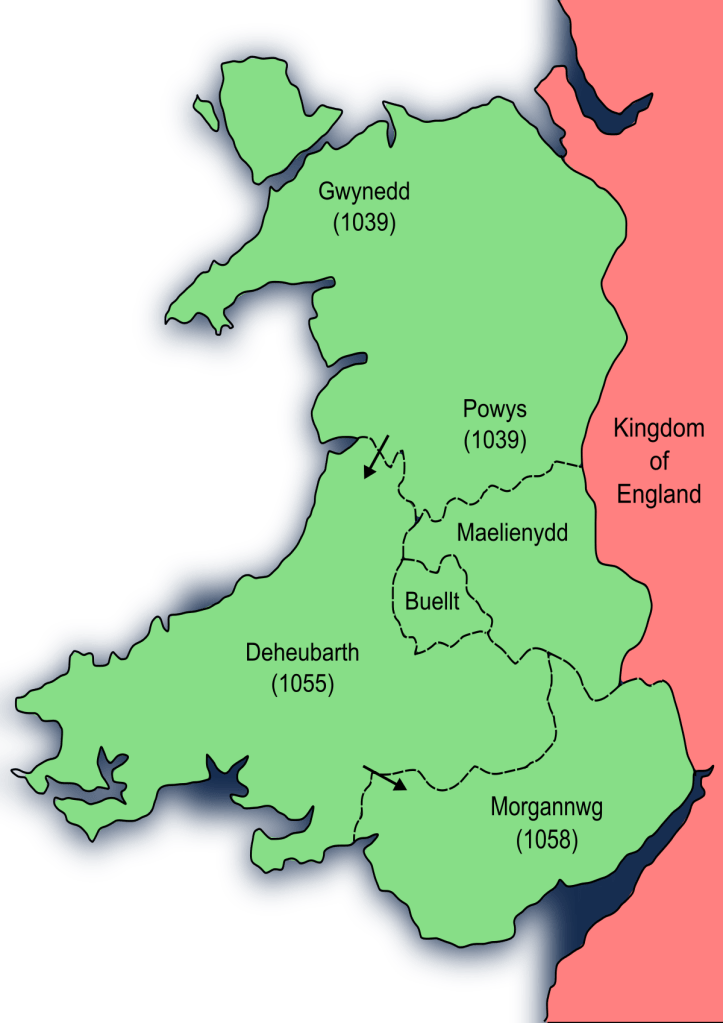
Wales is unified for seven years under the reign of Gruffudd ap Llywelyn (Source)
The only king to unify Wales is Gruffudd ap Llywelyn, who also defeats English armies winning territory from England, but only for a period of seven years between 1055 a 1063. Llywelyn is killed in 1063 by his internal enemies, after defeat by the last Anglo-Saxon king in Harold Godwinson, Wales again distributes into diverse kingdoms at the worst possible time.
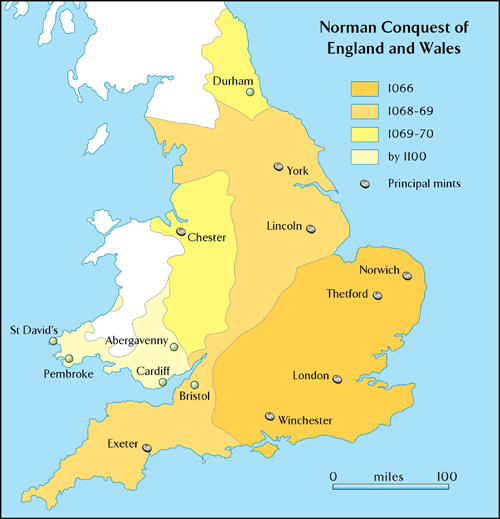
The Norman Invasion (source)
Wales suffers greatly from the Norman Invasion from 1066, and is conquered largely in its weakness, despite periodic counter-warfare in defence of Gwynedd and Deheubarth.
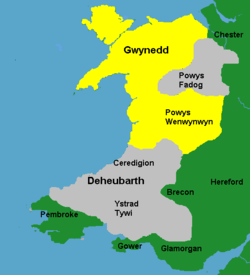

The rough borders of Wales in the Year 1217 (source)
Gwynedd again rises to prominence in the Thirteenth Century, with Llywelyn ab Iorwerth (Llywelyn the Great) Prince of Wales in 1195, and by his death in 1240 ruled most of Wales.
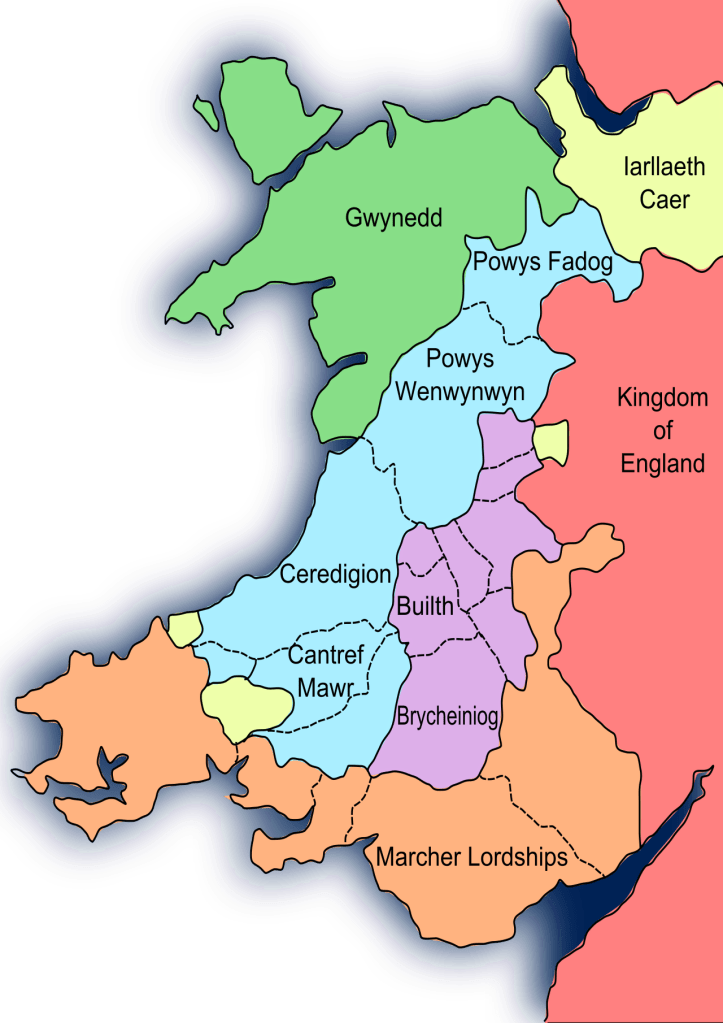
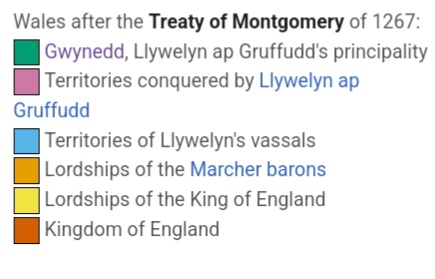
Welsh borders following the Treaty of Montgomery (source)
After a period of internecine squabbling, would see the rise of Llywelyn ap Gruffudd (Llywelyn The Last), grandson of Llywelyn The Great and the last true Prince of Wales negotiating the Treaty of Montgomery in 1267 with King Henry III of England, which unfortunately would not last long. The death of Henry and the crowning of Edward I (longshanks) would end with Llywelyn being deceived, ambushed and killed during a battle in Cilmeri in 1282.

The Ring of Iron – nine castles built at the command of Edward I to conquer and passify Gwynedd (source)
It is Edward I that ends Welsh independence and the stronghold of Gwynedd, and erecting a network of castles over North Wales to maintain control. He also decrees the Rhuddlan Statute of 1284, impinging upon the Laws of Hywel and a Constitutional change in absorbing the Welsh Principality under English Crown and Law. Longshanks crowns his conquering of Wales by making his son the first English Prince of Wales, and ever since 1301 the eldest son of the King of England has been invested Prince of Wales.
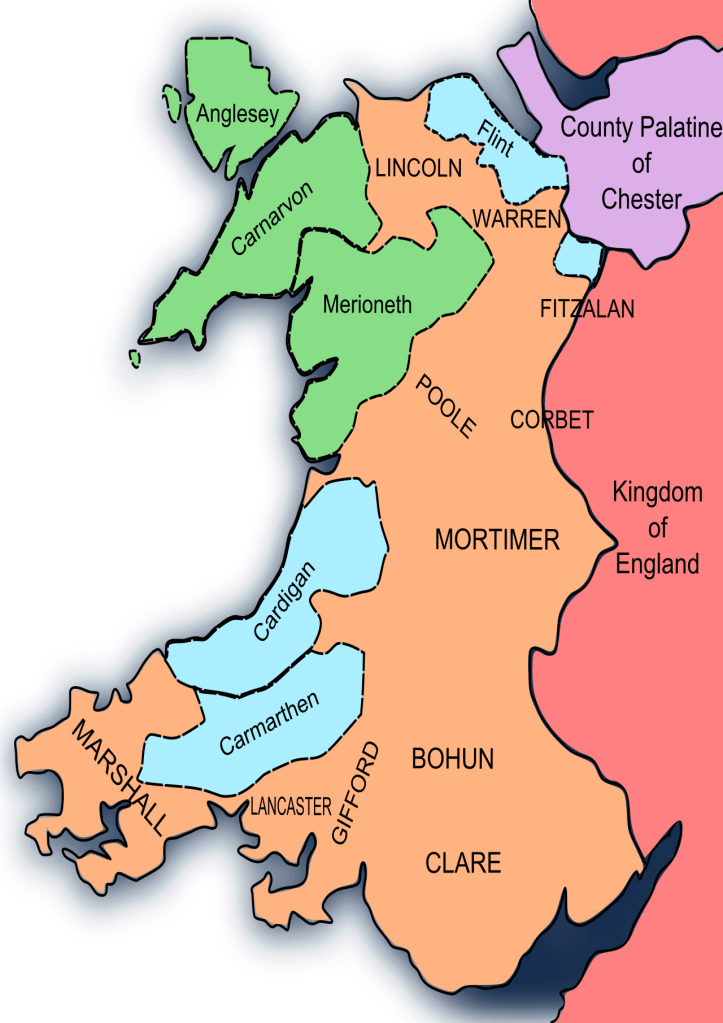
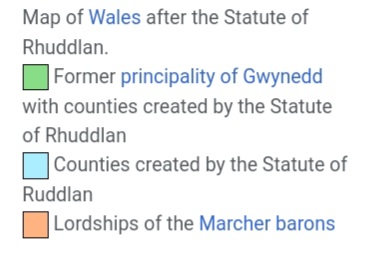
Welsh borders following the Rhuddlan Statute of 1284 (source)
Despite the end of the lineage of Gwynedd Princes with the murder of Owain Lawgoch by an English assassin in 1378, a self inheriting noble named Owain Glyndŵr rises to prominence defeating the English in a few battles, and for a short period rules Wales with the support of most of the Welsh. Owain establishes the first Welsh Assembly in Machynlleth, and plans for two Welsh Universities. Alas, the English eventually re-establish order, and Owain disappears into the shadows.
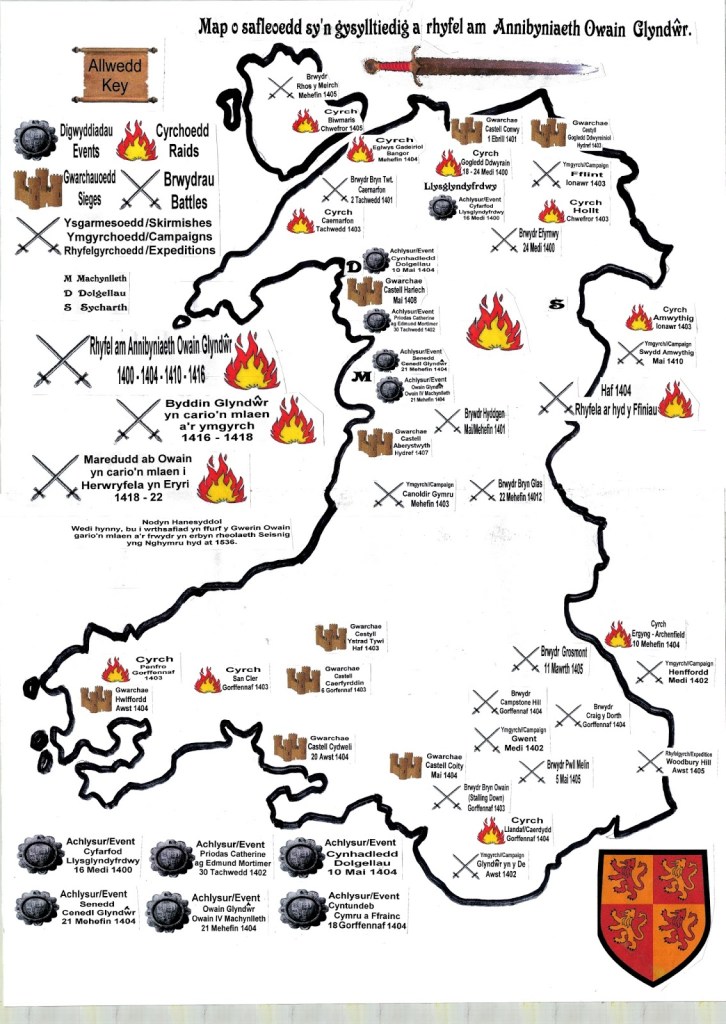
The fifteen year campaign of the “The Destined Son” against the English Crown (source)
With the beginning of Glyndŵr’s campaign, the English Parliament pass the Penal Laws of 1402, forbidding the Welsh from bearing arms, public office, or buying property in English buroughs, even though these laws would be inconsistently applied for the next century and a half.
Wales plays a prominent part in the Wars of the Roses between the Houses of York and Lancaster, in a three decade civil war over the English Crown, beginning in 1455.
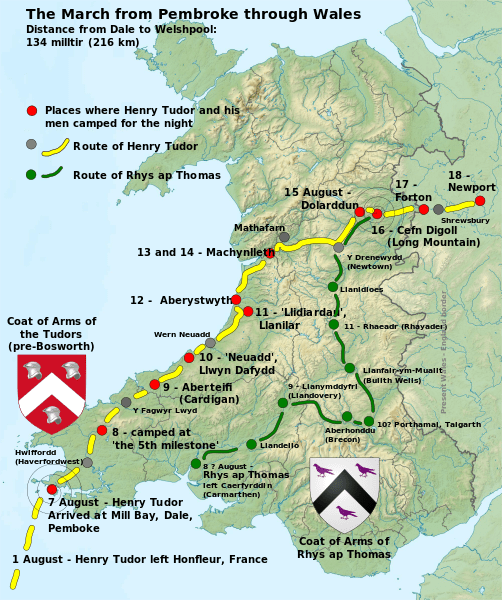
The journey of Henry Tudor from Pembroke to the English Crown, in August 1485 (source)
In 1485 Henry Tudor, of Welsh ancestry and claiming lineage from Welsh Princes such as Rhys ap Gruffydd, lands his army in Pembroke to battle for the Crown of England, with much support inside Wales. Henry’s armies defeat the forces of Richard III in the Battle of Bosworth including many Welshmen, and according to eye witnesses in Guto’r Glyn and Tudur Aled, it was Rhys ap Thomas that killed Richard. Victory promotes Henry to King of England, as Henry VII.
The Protestant Reformation
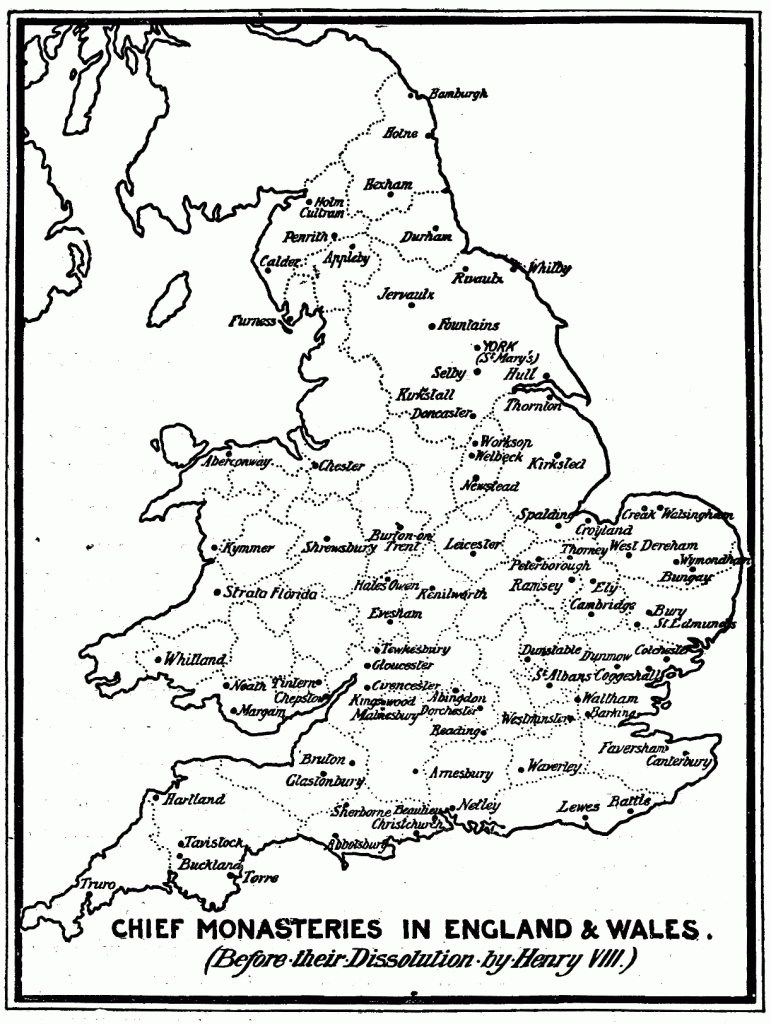
A thousand years of monastic and Catholic culture is sabotaged by a single madman (source)
We reach Henry VIII, the king that destroys the last millennium of English and Welsh history as Catholic countries, and the centrepoint of the Protestant Reformation in Britain. His divorce in search of a male heir leads to the creation of his own Church, the Church of England and Anglicanism, by stealing and destroying churches, desecrating the altars of saints, and dissolution of the monasteries of the “Old Religion’” over England and Wales. As the first king to weaponise Parliamentary powers against his enemies, and via the vandalism of Chief Minister Thomas Cromwell, the tradition of the monks end between 1536 and 1541. Henry is the first king to invade Ireland to undermine Catholic Ireland, following the Crown of Ireland Act 1542.
More importantly for Wales, Henry unifies Wales with England via the Laws in Wales Acts 1535 and 1542, extinguishing the remnants of Welsh Law and the Laws of Hywel, subjecting Wales to English Law. The Welsh Language is prohibited in official role or status, and for the first time the border between Wales and England becomes official, with the Shire/County system spread throughout Wales, for the first time giving Wales representation and Members of Parliament in London’s Westminster.

New Shire administrative order for Wales following the Acts of Union. One Member of Parliament for every Shire/County (source)
Following the vandalism of Henry VIII, Wales treads English footsteps into Protestantism and Anglicanism, with the publishing of William Morgan‘s Welsh Bible in 1588. The Bible standardises the Welsh Language and the dialects of North and South Wales, and the use of the Bible keeps the Welsh Language alive as an oral and religious language, against the creeping strength of the English Language in Wales.
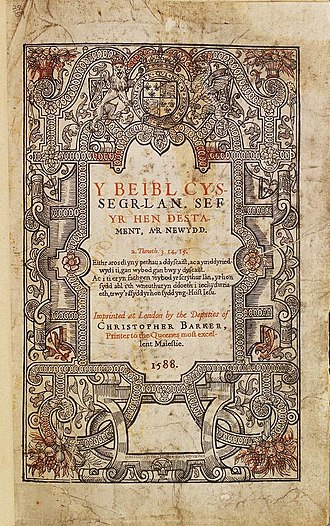
Wiliam Morgan’s Bible and the main reason Welsh is still alive as a language today (source)
The Civil War – The Parliament versus the King
Wales predominantly supports the Monarchy in the Wars of the Three Kingdoms (England, Scotland and Ireland) between 1639 and 1651 against London’s Parliament, and many Welsh soldiers would fight in the armies of Charles I. After succeeding in the Civil War, Parliament publicly chops off the head of Charles I in 1649, and England (and Wales) begins the experiment as a Republic or Commonwealth. The history of Oliver Cromwell and the Roundheads are especially bloody for Britain and Ireland, persecuting Catholics and supporters of the Monarchy.
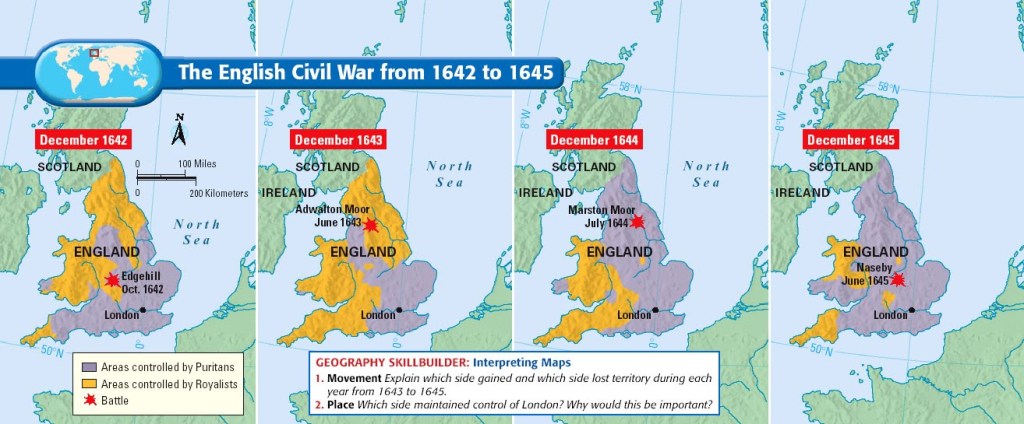
Wales remains monarchist on the whole despite Oliver Cromwell’s Welsh ancestry, and supporters like his brother in law John Jones, Maesygarnedd Member of Parliament for Meirionnydd and one of 59 signatures on the death warrant of Charles I, and the poet and author Morgan Llwyd (source)
Following the death of Cromwell there is a Restoration of the Monarchy in 1660, but tensions remain between Stuart Kings and Parliament culminating in 1688 with the Glorious Revolution, the deposition of Catholic King James II (VII) and imposition of Protestant King William III of Orange, with heavy Parliamentary backing. Catholics are forbidden from the throne under the Act of Settlement 1701, and Protestantism (and Parliament) takes over Britain once and for all.
The Pound, The Bank of England, and The Union
The Pound, Shilling and Pence (£sd) is a historical monetary standard based upon silver, established first in France by Pepin The Short (father of Charlamagne) in 755 AD, before spreading to the rest of Europe and to Britain. The pound therefore has been money in Britain for nearly a millennium before the invention of the Bank of England, with minting of coins initially by a distributed network of mints over the British Isles that eventually centralised (by Royal decrees) in the Royal Mint.
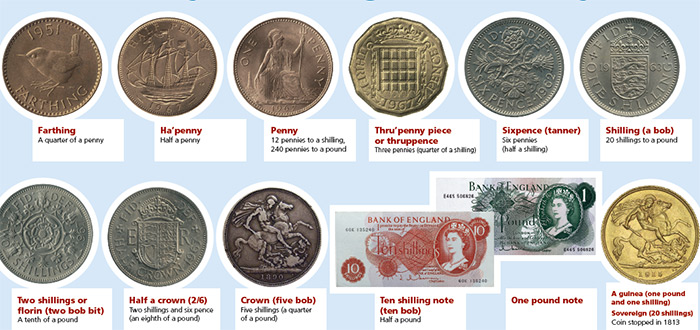
Britain’s monetary standard before Decimalisation in 1971 – Pound, Shillings and Pence. 12 pence to every shilling, 20 shillings and 240 pence in the pound. Values over a Pound became paper money (banknotes) with the development of banking (source)
Only six years following the Dutch Invasion of 1688, the Bank of Holland England is established in 1694, to finance the wars of the burgeoning British Empire against the Dutch and French Empires over the Eighteenth Century, beginning with the central planning of ironworks and agriculture.

The Bank of England’s charter and the detrimental centralisation of Britain via Pound Sterling (source)
One of the ealiest projects of the Bank of England is financing the Acts of Union between England and Scotland in 1707, enlarging a Customs and Currency Union via the British Pound. In essence, England bribes the Scottish Elite to create the Union despite centuries of prior Scottish wars to maintain independence, for the main reason that Scotland’s Government had very unsuccessfully founded a trade colony in the Darien scheme of New Caledonia (today’s Panama) that had completely failed, threatening Scotland with bankruptcy and forcing them into the Union and the Kingdom of Great Britain.
In the first half century the Bank would work on behalf of the government, in financing the Royal Navy to supervise the oceans between Britain and her foreign colonies, chiefly in America, but later in India, Honk Kong and China, the Far East the Middle East and Africa. The Bank of England initially has little direct influence over the financial system and the rest of the British banking system, that is distributed locally over Britain.
Over the Eighteenth Century however, the Bank’s influence over the financial system increases and centralises, and by the the Renewal Charter of 1781 the Bank of England has become the “banker’s bank”, with the rest of Britain’s banks using it for trade settlement, with BoE banknotes exchangeable for gold, under the Gold Specie Standard invented by Sir Isaac Newton in 1717, dislodging the Silver Standard as the metal of choice by the end of the Nineteenth Century.
The Bank Restriction Act 1797

Satirical cartoonist James Gillray lampoons London’s Parliament under Prime Minister William Pitt the Younger, for turning to the paper money printing press to finance the ruinous wars of the Empire (source)
Britain has defanged The Dutch Empire by 1800, leaving France as its biggest international rival. The bloody French Revolution decapitating Catholic Monarchy between 1789 and 1799 turns France upside down and worries Britain, and in 1793 Pitt’s Parliament declares war on France. To finance the Armies and Navies for the French Revolutionary Wars, it is decided to print an excess of Bank of England banknotes without the gold reserves in the Treasury to back them.
This fraud fractional reserve banking leads to bank runs in the North East of England late in 1796, and worsens once news spreads that French soldiers have landed in Pembroke for the Battle of Fishguard in February 1797.
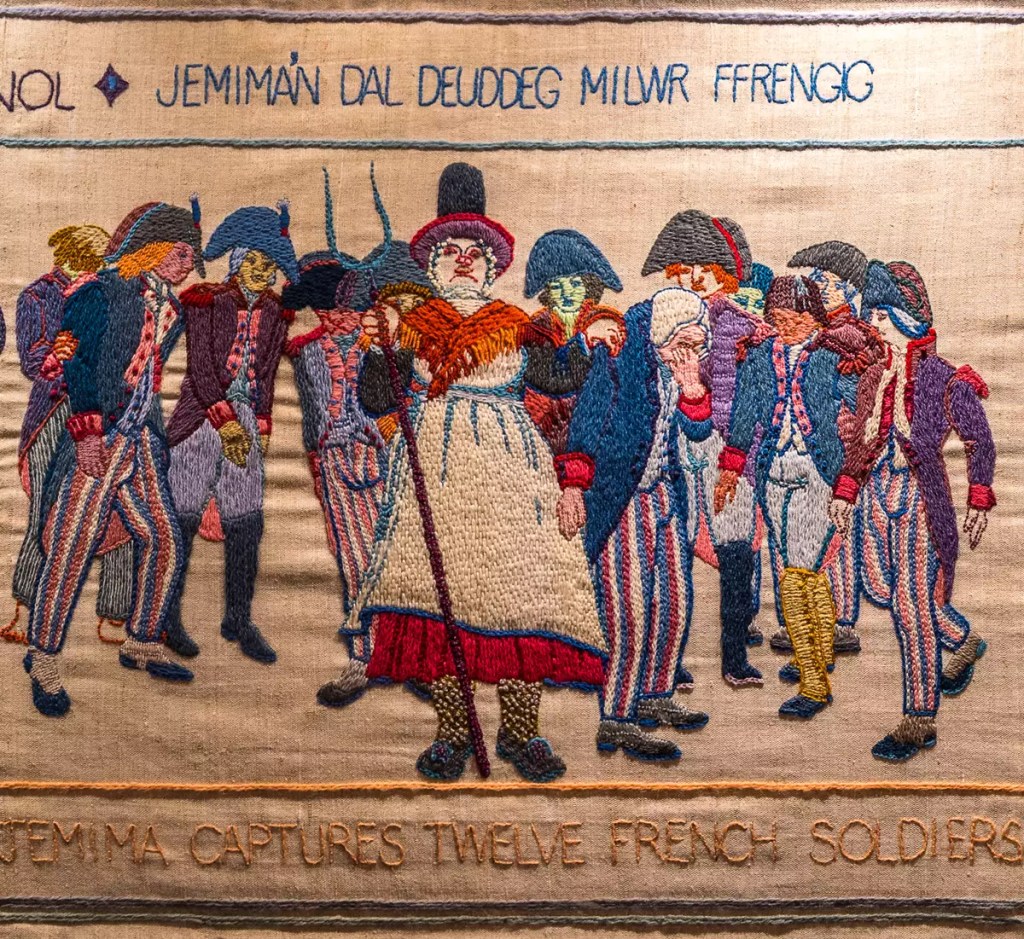
The legend of Jemima Nicholas rounding up French soldiers with her pitchfork in The Fishguard Tapestry, and the last time a foreign navy invaded Mainland Britain. (source)
The bank runs spark a panic in Parliament, and to avoid bankruptcy passes the Bank Restriction Act of 1797 forcing Britain off an internal Gold Standard to print the Napoleonic Wars (1803-1815) and the chronic inflation the domestic population has to suffer to defeat France, and establish Briain as the world’s greatest Empire over the Nineteenth Century.
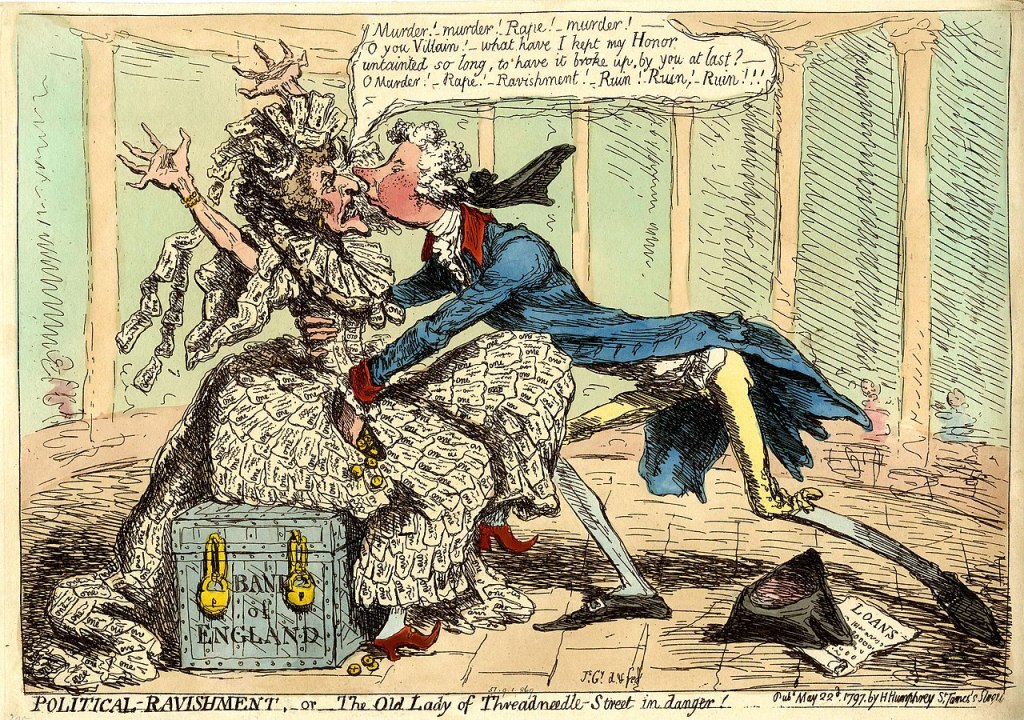
Another satirical cartoon by James Gillray mocking the fall of the Old Lady of Threadneedle Street to a back street political prostitute, seduced and ravished by William Pitt the Younger. The Bank’s historical nickname “The Old Lady of Threadneedle Street” derives directly from this artwork (source)
William Pitt’s vandalism of Britain’s monetary standards (not to mention the introduction of the first income tax in 1799) would sever the domestic gold standard for 24 years, until the 1st of May 1821, accelerating the massive changes within Britain during this generation, from English population explosion to the energy revolution and industrial and agricultural revolutions. Reneging on the gold standard is a historical pattern that repeats, and even though this was the first time for Britain it would surely not be the last…
The Industrial Revolution
(source)
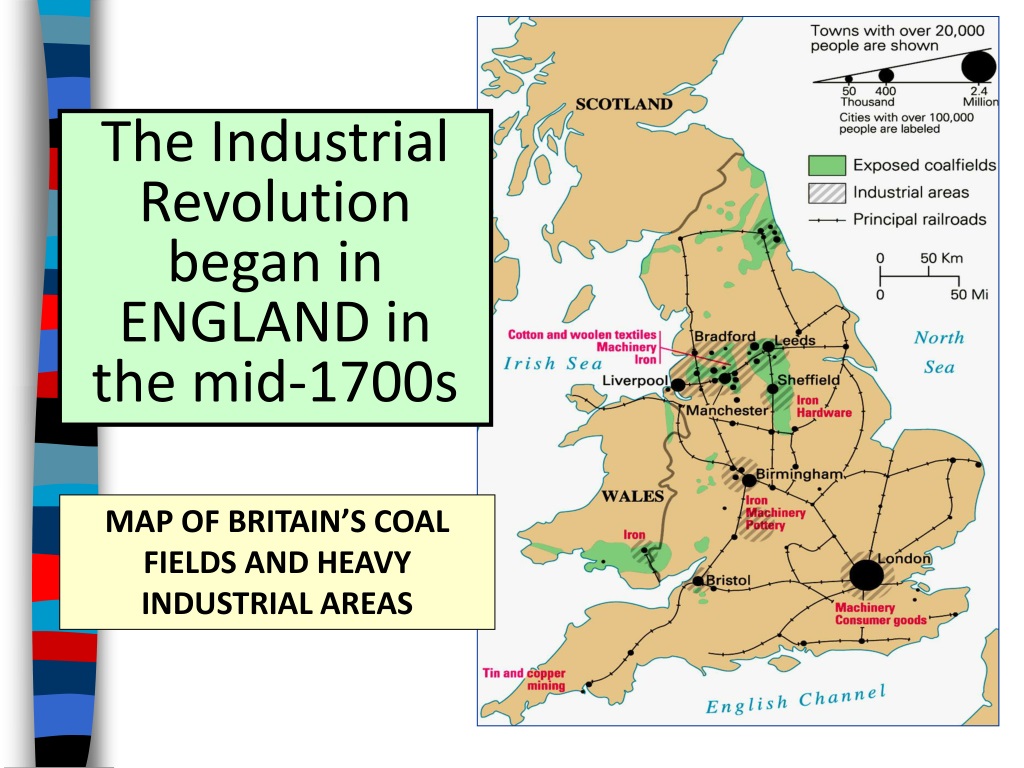
There is some disagreement on the beginning and end dates for the Industrial Revolution but roughly the Century between 1750 and 1850, barely half a Century since founding the Bank of England. The Watt Steam Engine is an important step forward in 1776, the same year as the American Declaration of Independence during the Revolutionary War of 1775 to 1783, against British Parliament and Empire.
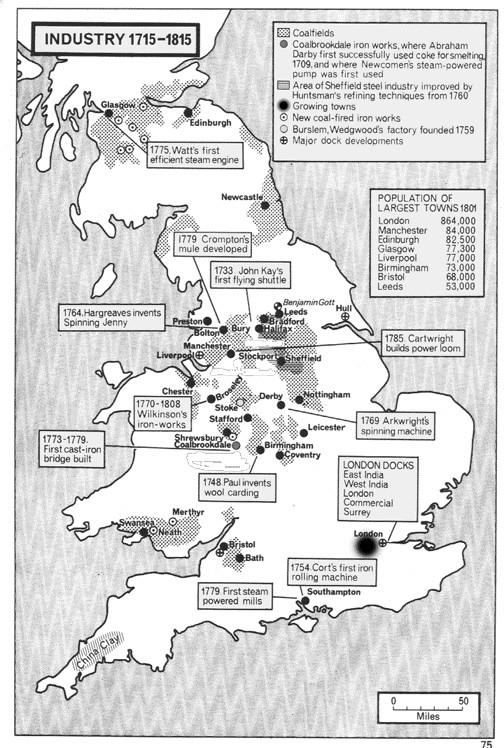
Coal, iron, steam and bank loans fuel the rise of the machines (source)
The Industrial Revolution is created out of London and the Bank of England, as it increasingly becomes a centrepoint for the British Banking system during the second half of the Eighteenth Century, accelerating with severing the Gold Standard in 1797, and explodes largely outside London and the South East, in the North and Midlands, the South of Scotland, and South Wales.
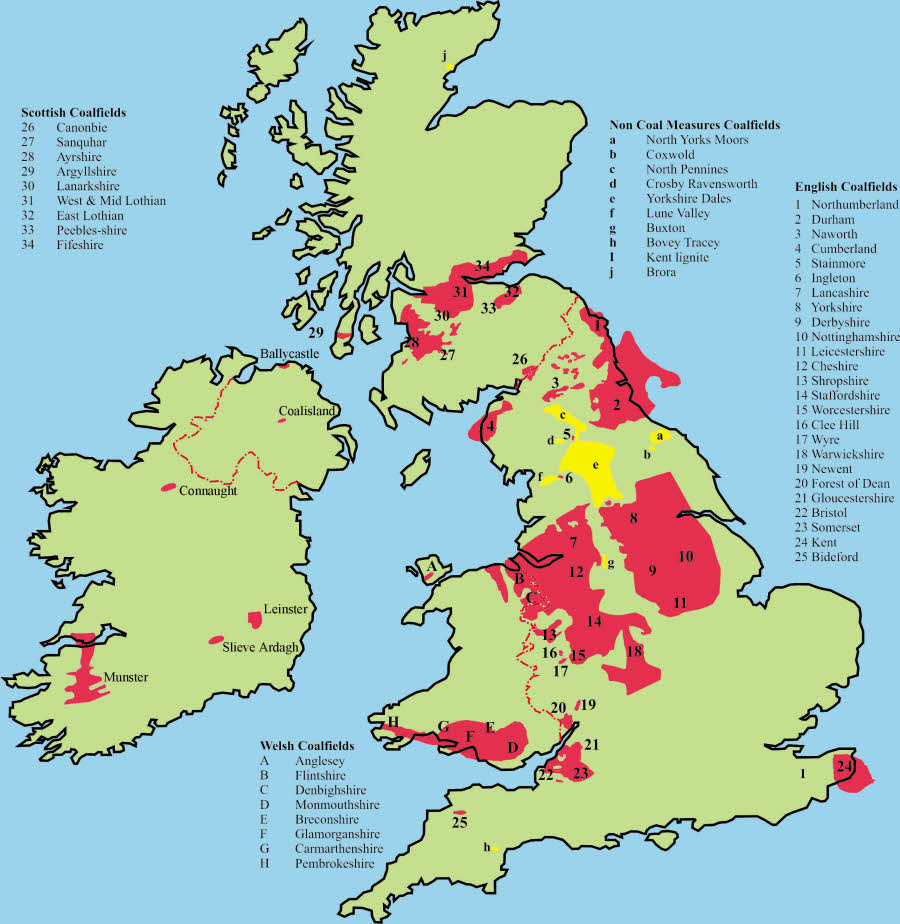
The Energy Revolution – geology and coalfields of the British Isles (source)
The energy revolution was based on geology, with discoveries and establishment of coal mines and pits to power industrial iron works over England, Scotland and South Wales. There is also an agricultural revolution, beginning to interfere with the traditional labour based rural economy, as the machines drove unemployment and migration from the countryside to create new industrial cities. In short, machines and machination explode throughout the British economy, co-inciding with England’s population explosion and the Child Labour revolution from 1800.
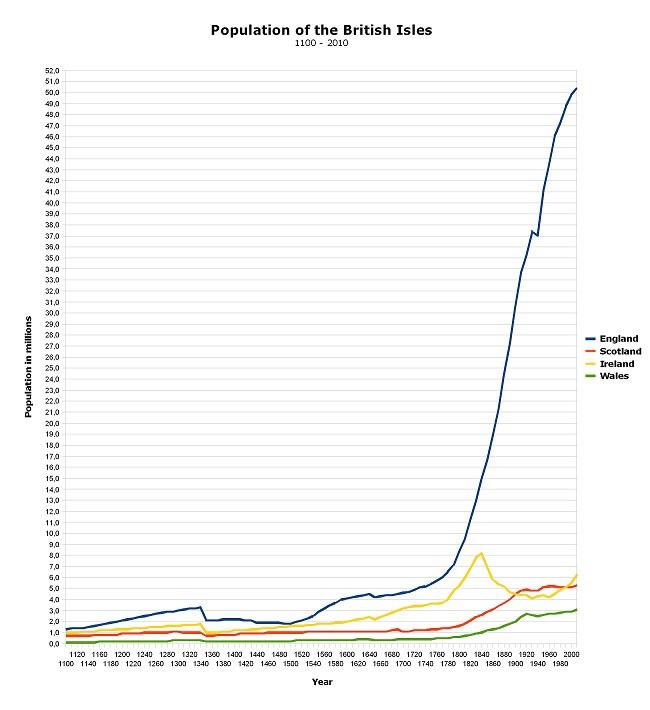
After rising on average by one million people every Century from 1100 to 1800, England’s population explodes from 8.3 million in the 1801 Census to 30 million by the 1901 Census (source)
The population explosion and rise of the machines eliminates labour, creating huge unemployment in the English countryside particularly, therefore forcing the rise of English industrial towns and a workforce for the factory system to increase the Country’s productivity, alongside the revolution in child labour to maintain families living standards due to the grinding poverty fueled by the debasement of the Pound’s purchasing power. The Industrial Revolution exhibits all the symptoms of inflation, first in the money supply and loss in purchasing power, inflating family size, the population, and demands upon energy, industry and machinery.
South Wales plays a prominent part in the Industrial Revolution, in the coal and iron industries. Following the invention of Watt’s condensing steam engine, Cornish mining engineer Richard Trevithick would develop the earliest train and railways for coal fields and iron works, two decades before public trains and railways. The first recorded steam hauled railway journey is February 1804, from the Penydarren ironworks near Merthyr Tudfil, down to Abercynon.
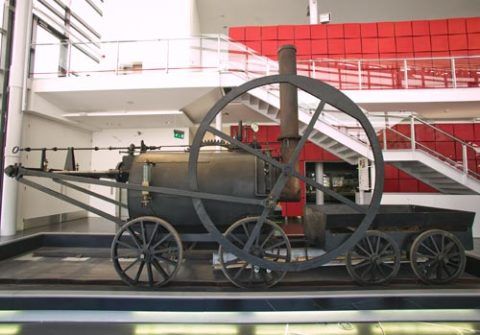
The Penydarren Loco – the world’s oldest locomotive in the Welsh National Museum (source)
The Industrial Revolution has enormous effects upon the power structures within Wales, away from the North and the historical supremacy of Gwynedd, down to the South Wales valleys and the industrial cities of Cardiff, Swansea and Newport. The population of South Wales explodes compared to the North, as English and other outward migration swamps the native Welsh population. By statistics, the population of South Wales doubles from half a million to over million between 1801 and 1851, and doubles again to 2.4 million by 1911.
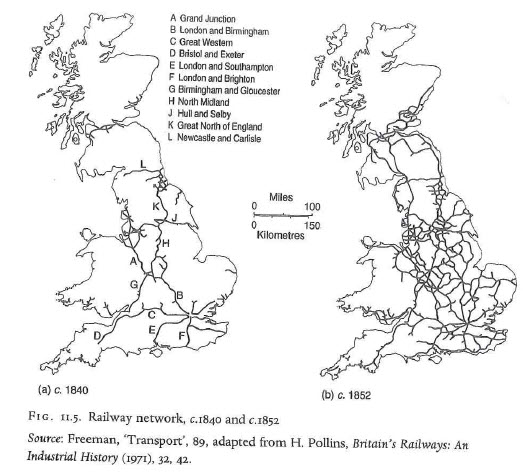
The Public Railways explode in the mid 1840’s, mostly due to the Bank of England lowering interest rates and hundreds of Parliamentary Acts passed by greedy politicians profiting from the Railway Mania (source)
The first half of the Nineteenth Century co-incides with the last half century of the Industrial Revolution in Britain, with the spread of public railways and trains, enabling tourism and immigration and the opening up of Britain, undermining localism and cultural diversity as London and Westminster politics takes more control over the infrastructure of the island. Industry and transportation also transforms Cardiff and Swansea into rich and powerful port cities of the Empire. Industrialism in its nature also centralises power and control, mostly in English hands, leading to Welsh counter-rebellion on occasion. The Merthyr Rising is one but example, in 1831 during a recession amid unemployment and low wages, the natives riot against the ironmaster William Crawshay, calling in the British Army to maintain order, and the hanging of Dic Penderyn and exile of Lewis Lewis to Australia. The rise of Labour Unions and Socialism will play an important part in the future of Wales, with Keir Hardie elected as the first ever Member of Parliament for the Labour Party in Britain, in Merthyr Tudfil in 1900.

The Red Flag symbolic of Socialism and labour revolutions, flown for the first time in Merthyr Tudfil in 1831 (source)
Under the Prime Ministership of Robert Peel, London’s vice grip over the rest of the Union via the British Pound would also strengthen. In 1844 the Bank Charter Act makes the Bank of England’s Banknotes legal tender, prohibiting any other bank from issuing their own banknotes. Even though the BoE is still an institution with private shareholders, its banknotes are nationalised throughout Britain by Parliament.
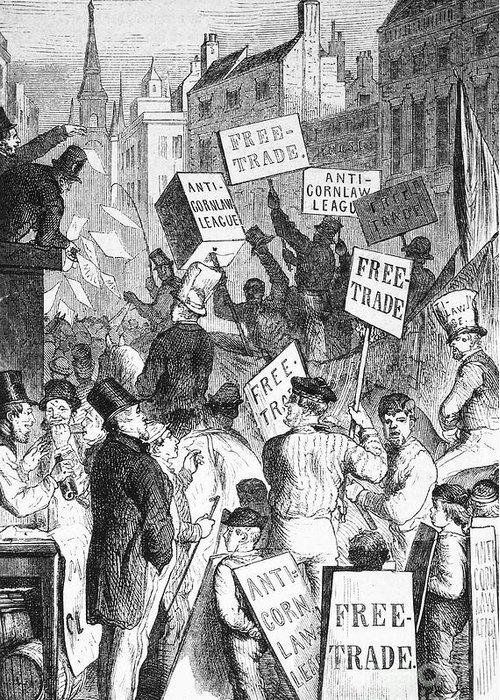
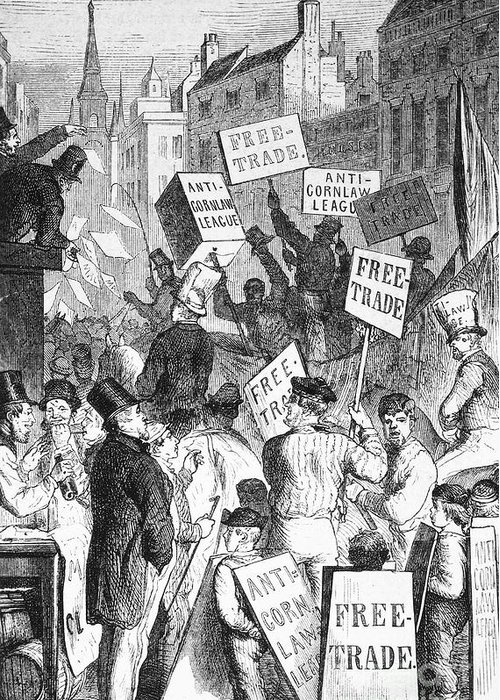
A Conservative Government turns its back on Mercantilism, and takes the Liberal path towards Free Trade (source)
Additionally, in 1846 a Conservative Government repeals the Corn Laws splitting the Party and forcing the resignation of Peel, the shift toward Free Trade and promotion of financial flows into Pound Sterling and London as the World Reserve Currency and Financial Centre of the Nineteenth Century, while undermining the long term by running trade deficits with its two main international competitors, Germany and the US.
Indeed, in 1850 the British economy is twice the size of the United States but by 1900 the British economy is half the size of the US, and the same size as Germany who under the Chanchellorship of Otto von Bismarck following the founding of the German Empire in 1871, had adopted Mercantilism and the American System of protective tariffs on imports. The by-product of a half century of Free Trade was to build up the economic forces of the two main countries that would end the hegemony of Britain as the world’s biggest Empire in the First World War.
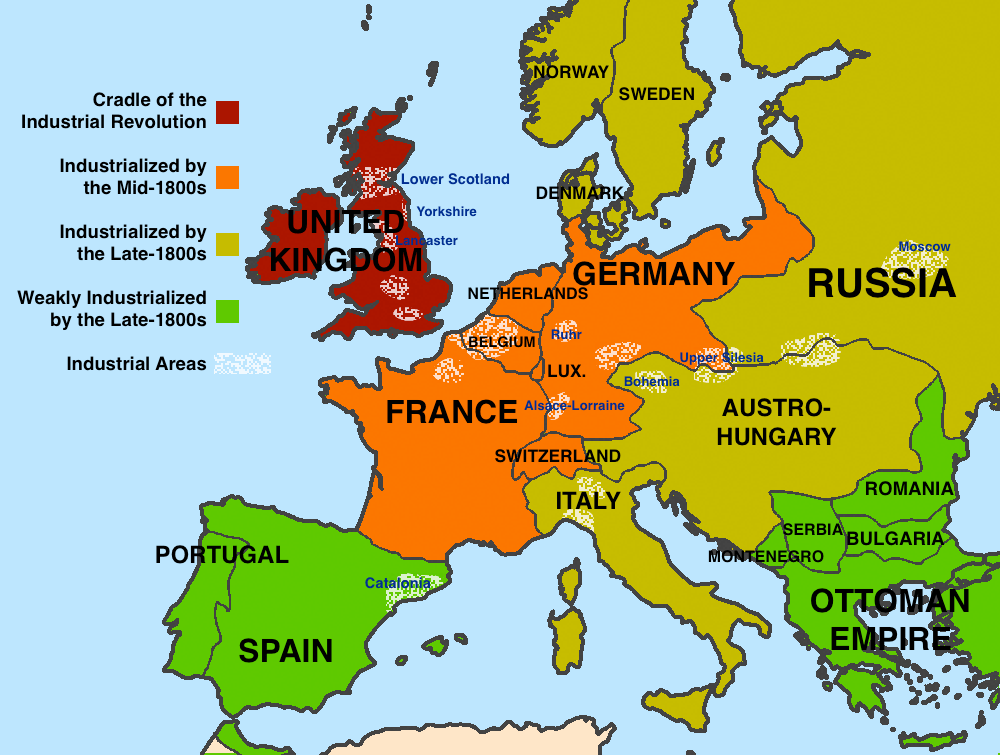
The Nineteenth Century witnesses the export of the Industrial Revolution, Empire and Central Banking to the rest of Europe and the United States (source)
The Twentieth Century
With the growth of the German Empire by the beginning of the Twentieth Century to the same size as Britain, they have become a threat. Germany would have likely defeated France and Russia in a continental war enlarging their empire a little to the West and East, but Britain as the world’s foremost Empire creates the First World War by joining the Allies to halt the further growth of Germany.
Britain and Europe abandon the Classical Gold Standard, extending the War from six months to a genocidal four years that destroys the Monarchical governing structures of Europe, destroys Britain’s future as the World’s biggest Empire, and establishes its dependence on the United States to win wars and the gradual transition of the world’s policeman over the Atlantic.
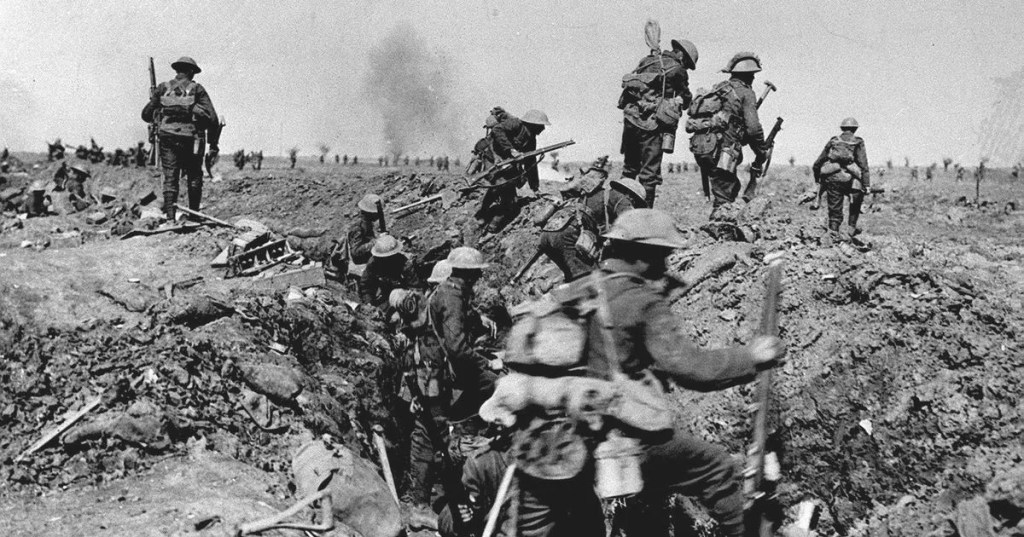
An estimated 35,000 Welshmen are killed in the First World War (source)
The evidence of the destruction of the First World War can still be seen today, in every cemetery in the villages, towns and cities of Britain and Europe, the genocide of a generation of Europe’s finest men, plunging a generation of families into grief and poverty, the first industrial war, and the destruction of an economy via inflation and shortages. Thanks to the warmongering Winston Churchill and David Lloyd George, dragging Britain into the war that cripples its future.
The inter-war years are hard times for Wales after losing so many men in the war and in every village, as poverty increases over the period. The Labour Party replaces the Liberal Party in the industrial valleys and population centres of South Wales, as Socialism and Labour Unions takes hold, and essential to the growth of the Labour Party and the Nationalisation of Welsh and British industry to come.
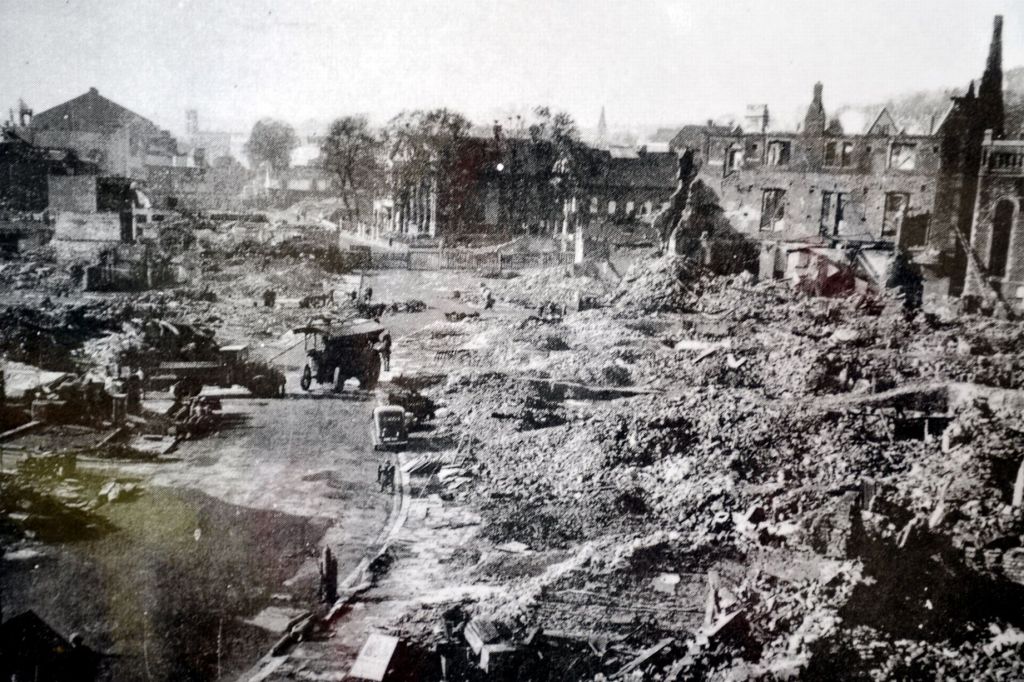
In addition to losing an estimated 15,000 Welshmen, the Second World War comes home through the bombing raids of the German Wehrmacht targeting British infrastructure, especially the port cities of Swansea and Cardiff (source)
The Second World War destroys the populations and countries of the UK, Europe and Russia for the second time in a quarter of a Century, leaving Britain essentially bankrupt as Pound Sterling and the Bank of England cedes World Reserve Currency status to the United States and the Federal Reserve. The US establishes the Gold Exchange Standard aka the Bretton Woods System, fixing the gold price at $35 an ounce, with the British Pound being exchanged for it. To rebuild Britain and Europe following the war, the US finances the Marshall Plan with Britain receiving a £5 billion loan, 26% of the total.
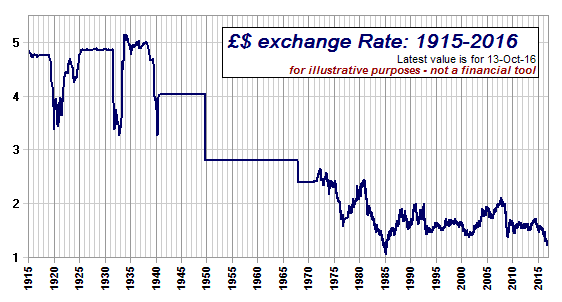
The Pound is devalued to 4 dollars following the Bretton Woods agreement, meaning an ounce of gold was £8.75 following the war. For comparison, to demonstrate the unending debasement of Sterling over the last eight decades, an ounce of gold today is over £2,000! (source)
Post War Britain – Shadow of the Sickle
After leaving Eastern Europe in the hands of Stalin, in 1946 Communism comes home to Britain, under Clement Attlee’s Labour Party following the landslide defeat of Churchill and the Conservatives in the Election of 1945, Britain’s economy and infrastructure is nationalised.
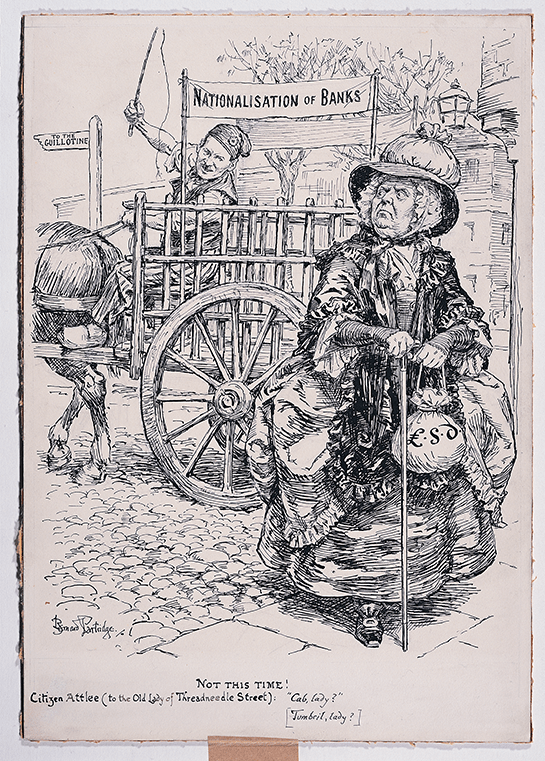
Punch Magazine’s satirical cartoon from 1935 portraying Clement Attlee offering a lift to the Old Lady of Threadneedle Street, on her way to the guillotine. Eleven years later, it is realised (source)
The most important element of perpetuating Nationalisation and financing Communism, is the Bank of England itself in 1946. After existing as a bank with private shareholders for 252 years, two years after Bretton Woods and loss of World Reserve Currency, the Bank is now owned by the Parliament of Westminster.
To follow, the Nationalisation of the Country:
In 1946 the coal industry is nationalised with the Coal Industry Nationalisation Act.
In 1946 healthcare, with the National Health Service Act and National Insurance Act, expanding the Welfare State under Health Minister Aneurin Bevan.
In 1947 under the New Towns Act and Town and Country Planning Act, the government gets into Social/Council Housing and the construction of new centrally planned towns to ease the overpopulation of cities such as London and Glasgow, creating a myriad of new social problems from unemployment and welfare, driving poverty and crime.
In 1947 the Transport Act nationalises the highways, the railways, the canals, ports, bus companies and even lorries!
In 1947 the Electricity Act fully nationalises the Electrical Grid, alongside Cable and Wireless (Telegraph and Telephone).
In 1948 the Gas Act nationalises the Gas Industry.
In 1949 mae’r Iron and Steel Act nationalises the Iron and Steel Industries.
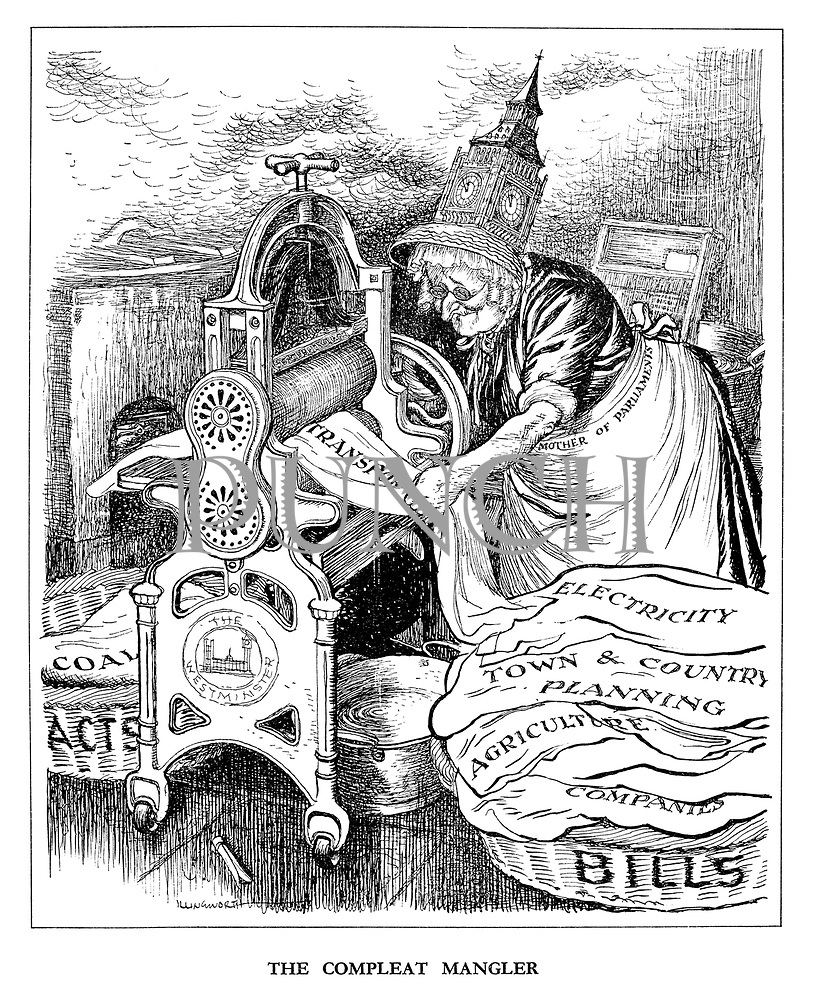
Another satirical cartoon from Punch Magazine, depicting the predictable catastrophe of Government controlled infrastructure, via the mangle of Westminster (source)
In effect, the Labour Party and British Government become owners of South Wales industries, and so South Wales becomes a hostage to the whims and perfidy of London’s Parliament for their economic future and way of life.
Outside the urban and industrial centres, in the countryside by some mercy the Agricultural sector escapes full Nationalisation and repeating the famines of other Communist countries such as Soviet Russia and Maoist China, but even in the greenest depths of rural Wales the shadow of Socialism and Central Planning threaten the old Welsh way of life, strikingly depicted by Islwyn Ffowc Elis in the Welsh Language novel Cysgod y Cryman (Shadow of the Sickle) published in 1953, and awarded Welsh Book of the Century in 1999.
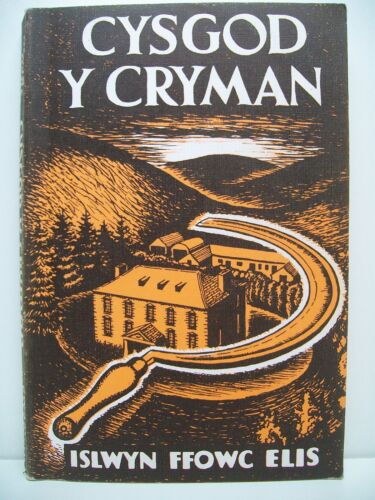
Book of the Century – the Sickle is of course Communism
Welsh Nationalism strengthens following the War, and even though Plaid Cymru had been established since 1925, it takes until 1966 to win its first seat in Westminster. In 1967 the Welsh Language Act gives rights to the use of Welsh in the legal system within Wales, that had been illegal for over four centuries.
The Stagflationary Seventies – End of the Gold Standard
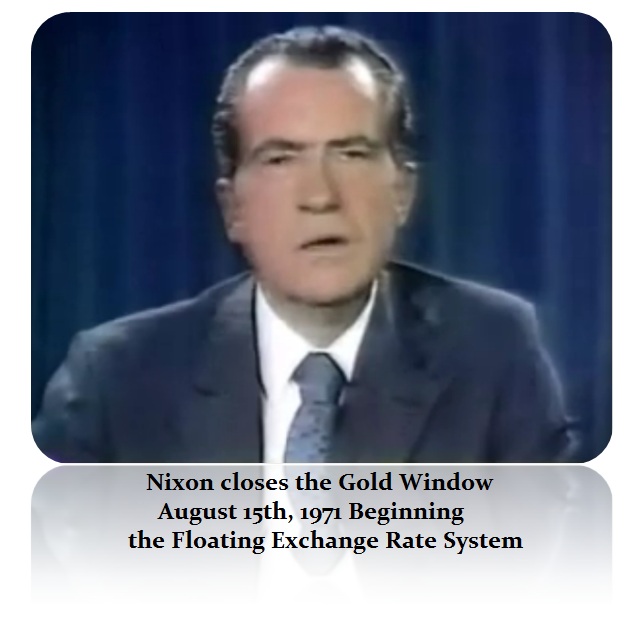
The United States defaults on settling its debts in gold – the leash upon inflation is severed
In 1971 Richard Nixon takes the US off the Gold Exchange Standard onto The US Treasury Exchange Standard and National Debt machine, severing the leash upon the purchasing power of money, sending inflation of living costs to the moon in the Seventies.
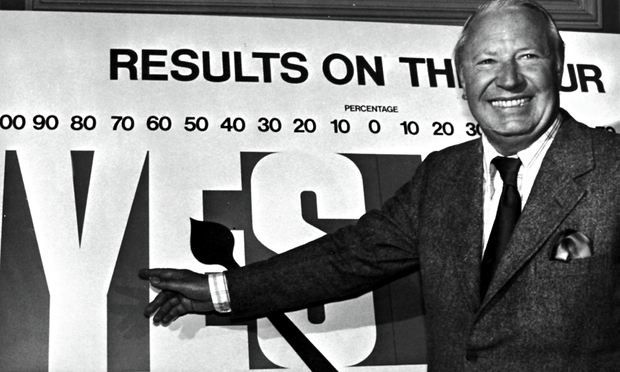
Primary Architect of dragging Britain into a bigger, centralised trade union – Edward Heath and the Conservative Party (source)
1973 is an important year, as the Tories swindle Britain into the EEC as the European Union was called back then, in an age when Conservatives were Europhiles and Labour were Eurosceptics, concerned over the future of domestic Labour Unions and British Industry in an enlarged customs union, and the foreign tide of cheap goods and labour undermining the Unions, domestic industries and the nationalised electorate of the Labour Party. The half century since have confirmed the concerns of Old Labour about the Union of Britain with the Continent, and our current Trade Deficit of a hundred BILLION per annum with Europe (especially Germany) has massively contributed to the undermining of the British industrial economy since the Seventies.

The Three Day Weeks that last three months in early 1974 ending Ted Heath’s political career, Labour retake power in the Elections of February and October 1974 (source)
The chronic inflation of the Pound in the early 70’s drives national industrial strikes over Britain to increase wages to protect workes and families enduring a cost of living crisis, especially the Miner and Railway strikes of 1974, forcing the Tories into Three Day Weeks on companies and industries to conserve electricity between January and March, that also ends Tory Rule in the second General Election of 1974 as Labour return to power.

The Sterling Crisis in 1976 forces Britain to default on its debts and beg the International Monetary Fund for a bailout (source)
In 1976 the Government of James Callaghan defaults on loans and is forced to seek an IMF bailout, a humiliating episode for the Country that had run the world only a few decades earlier. It is remembered as the Sterling Crisis and the loan of £4 Billion, the largest in IMF history up until then, to prop up the exchange rate of the Pound suffering 10% annual inflation rates, echoes the last few years the UK has suffered since the Covid Crisis debacle.
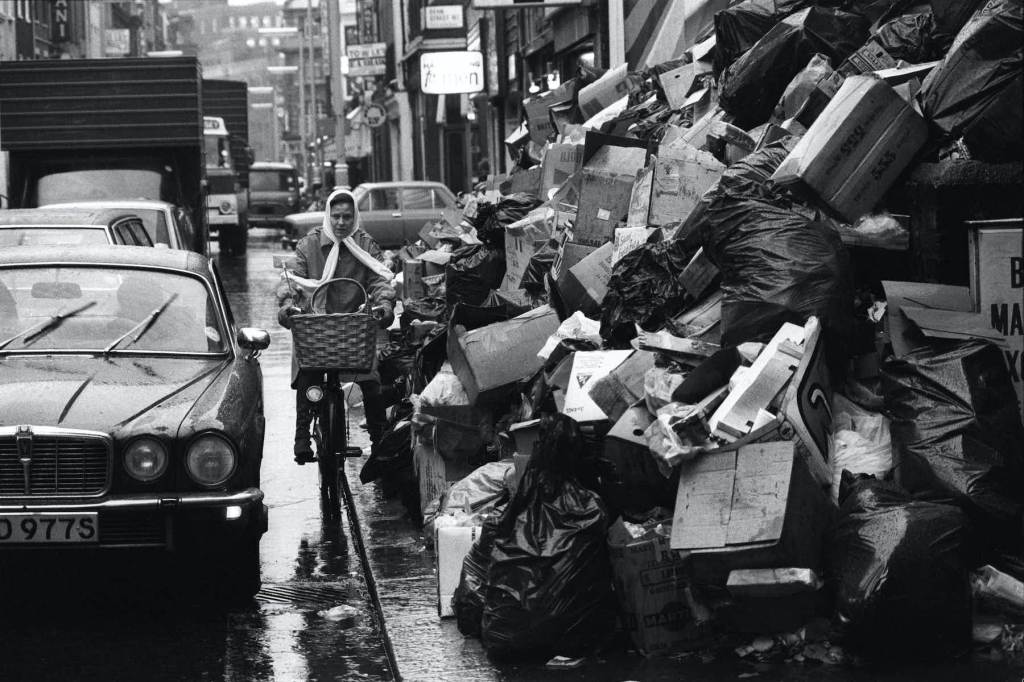
Union strikes meant that rubbish collection was suspended over the towns and cities of Britain in the Winter of 1978 (source)
The Winter of 1978 is remebered as the Winter of Discontent, with labour union strikes bringing the Country and the Labour Party to its knees, and paving the way for Thatcherism and the Conservative Eighties. The strikes of the bin men chokes the towns and cities of Britain in rubbish, and strikes amongst the grave digging unions stopped the dead from being buried. Three decades of nationalised infrastructure and unions in every major industry nearly brings Britain to a halt for wage bargaining, all because of the chronic mismanagement of the common currency, the Pound, comes close to destroying Britain.
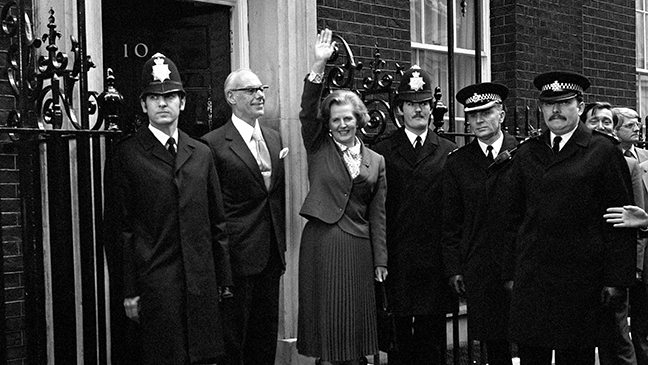
Prime Minister Margaret Thatcher following the 1979 Election (source)
In the last year of the turbulent Seventies, Thatcher and the Conservative Party gain power, that will decimate the industries and economy of South Wales during the Eighties, the peak of Welsh Industry and labour union leverage over the British economy ends with the sweeping away of the Labour Party following the 1979 Election.
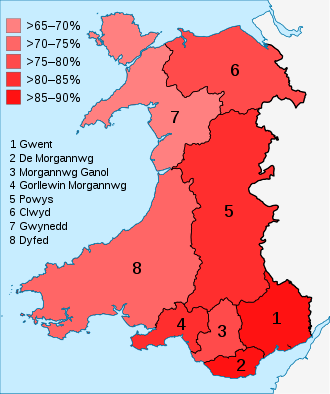
The percentage against Devolution for Wales – even in West Wales two thirds voted No! (source)
Additionally, on the First of May (St David’s Day) 1979 Wales receives a Referendum on Devolution and a Welsh Assembly, and a stregth test within Scotland and Wales for the Union, and any strength in Welsh Independence. 80% of the Welsh public vote against the referendum and only 20% in support, closing the debate around any devolution for the next twenty years.
The Eighties – Privatisation
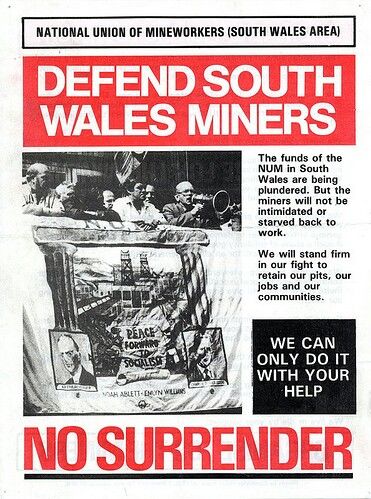
The Miner Strike of 1984-5 against closing South Wales collieries, and other coal areas in Britain. The Coal Industry was privatised and put out of business nearly overnight (source)
The Eighties are of one of Welsh history’s most destructive and saddest decades, removing much of its power and influence, especially Welsh labour workers over the rest of the Union, and most of this is down to one woman, in Maggie. But before she is dragged out of her grave for recrimination, she must be discussed in the context of the earlier mistake in Nationalising the energy and heavy industry sectors.
As already discussed, the beginning of the destruction of the Eighties is in the Fourties, and the Nationalisation of the coal, gas, electricity, transport, and steel industries. Central Planning and working outside of any profit motive in competitive industries, suffers from the “Socialist Calculation Problem“, in that because the government does not have to run on a profit to survive, it is impossible to ascertain what is profitable and what is not. It was becoming increasingly clear that the British Government was running Britain’s heavy industries at a massive loss, reflected in large part by the inflation and monetary problems of the Pound during the Seventies.
By the Eighties, British Industry had become increasingly uncompetitive with rest of the European Union and the World, lacking investment in new machines and engineering, and over dependent on labour and the unions that had become powerful, and could bring the British economy to a halt with strikes. This is a major reason in Thatcher’s decision to break the unions, via privatisation of Britain’s public companies, and the following list gives a flavour of the extent of public ownership: Royal Mail, Capita, British Aerospace, Cable & Wireless, British Gas, British Coal, British Telecom, British Steel, British Petroleum (BP), Rolls Royce, British Airways, Water Boards, Electricity Boards, National Power, Powergen, British Rail.
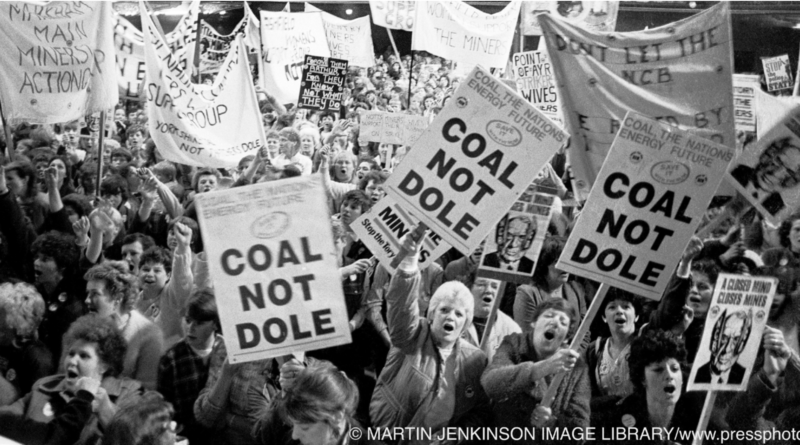
Instead of continuing to subsidise industrial areas creating domestic energy and commodities strengthening independence and national security, the Tories throw everyone on the dole prefering to subsidise unemployment and despair instead (source)
Where Thatcher and the Conservatives deserve judgement was in a chaotic and premature privatisation, throwing large swathes of Britain’s heavy industries out of work overnight, creating mass unemployment and poverty in British industrial heartlands and especially South Wales, feeding the Welfare State and Government subsidies for not working, and the second order effects of alcoholism, drug addiction, crime and suicide. Indeed, Welsh wounds have yet to heal since the Eighties. Privatisation has also, in many cases, put these state sponsored monopolies in the hands of people who have ravaged the institutions for a small gang of private shareholder profits, at the expense of inferior and more expensive utilities for the public that subsidise it through bills and/or taxes. Many of these companies have become worse and under-funded than in direct government hands, meaning that today we have another brewing infrastructure crisis in Britain, see the condition of the railways and the Thames Water scandal recently. Privatisation and mismanagement in many examples have degraded our infrastructure and made us more dependent on foreign imports from other countries for resources such as steel, coal and gas.
The Nineties – Decentralisation Emerges

Time Magazine Cover, November 1994 – the year the Internet was privatised (source)
It could be argued that the trend of political centralisation that began with the Protestant Reformation five Centuries back, reaches its peak under the Labour Party at the end of the Fourties or under Labour in the late Seventies, the Eighties was the beginning of a new trend of devolution and decentralisation, but it is the Nineties that sees the decentralisation of communication, confirming a multi-decade trend of decentralisation. Critical to this trend is the internet, previously a communication technology reserved for National Militaries, Educational Institutions and within the Public Sector, privatised in 1994 for the public over the world to use. Despite little demand in the beginning, as few of the public had a computer or internet access, three decades later digital technology has changed all our lives and we are today undoubtedly completely dependent on our mobile phones for mobile banking, e-mails and social media for information and communication. Indeed the explosion of online peer to peer communication in the last thirty years is undermining the power and influence of the legacy media that once monopolised the flow of information, and is contributing to the increasing censorship of the internet and online, as Politicians and the State wake up to the perils of freedom of speech, and our judgements on the madness and incompetence of our political elites who believe they are above any judgements. Despite the increasing Parliamentary Acts to “Protect Safety” and taxpayer funds thrown at calming the “anti-democratic” waters via restrictions and banning the freedom to broadcast and communicate online, the ongoing trend of tension and struggle between the forces of centralisation and decentralisation will increase for the next decade.
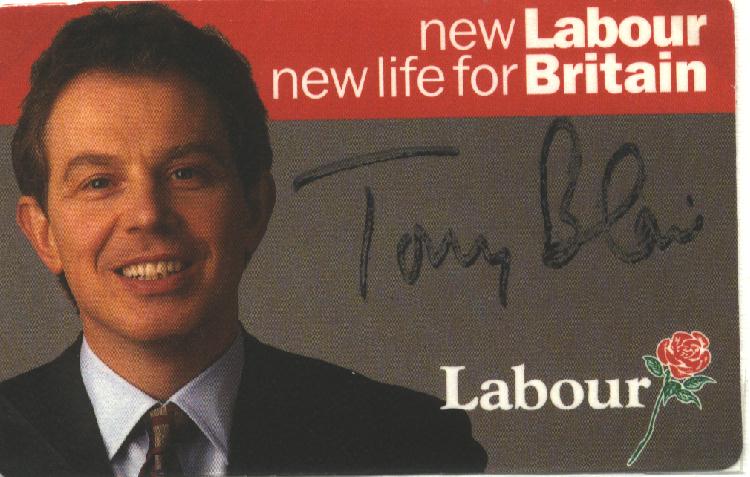
New Labour (minus the Union), and the Conservatives in Red (source)
By the late Nineties eighteen years of the Tories has become too much, and with New Labour’s landslide in the 1997 Election and the coming of Tony Blair and Gordon Brown, there is the promise of hope for a demoralised Wales within the Union. In keeping with the origins of the Labour Party and Kier Hardie in the South Wales valleys, three of Labour’s original four pledges are realised by New Labour, in Devolution, the Minimum Wage, and the abolition of heredity in The House of Lords. The only pledge to fail is the prohibition of alcohol.
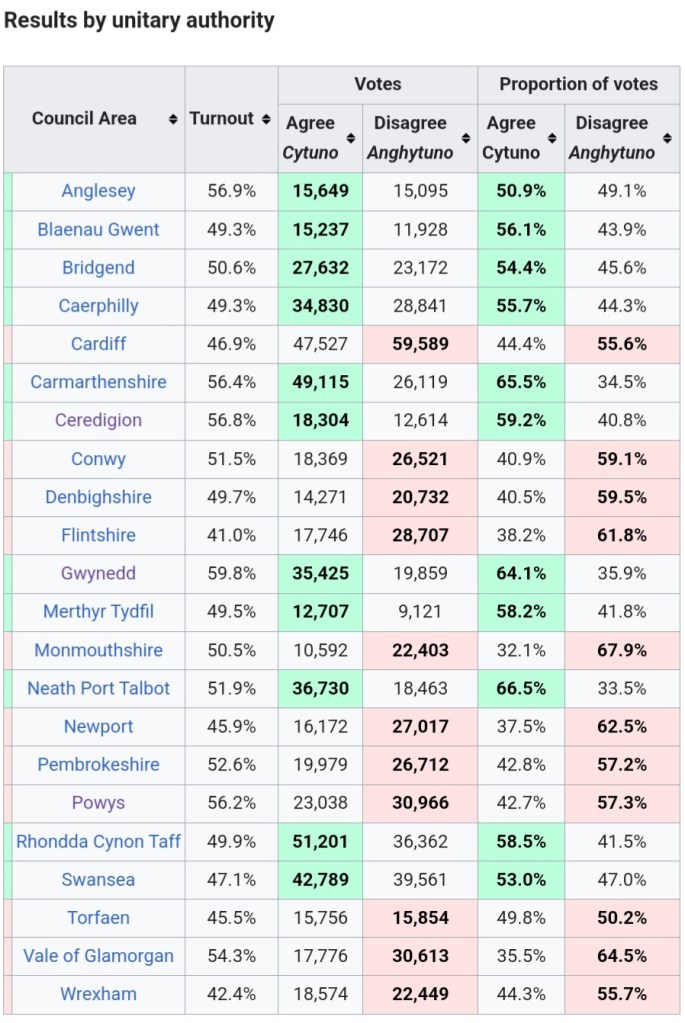
Wales, thanks to the South Wales valleys, votes marginally for Welsh Devolution (source)
Devolution of the Union is realised after Labour victory with the 1997 Referendum, and in 1999 the National Assembly for Wales is established after Wales narrowly votes in favour. The Assembly becomes the Senedd in May 2020. It can be argued that Devolution has been a success with new Welsh Government powers, it could also be argued that Welsh Devolution has been a failure due to the monopoly of the Labour Party in Wales socialising and slowly killing off Wales productive sectors, with the public sector and its destructive policies addicting Wales further to London’s Treasury.
Brexit 2016 – Further Devolution
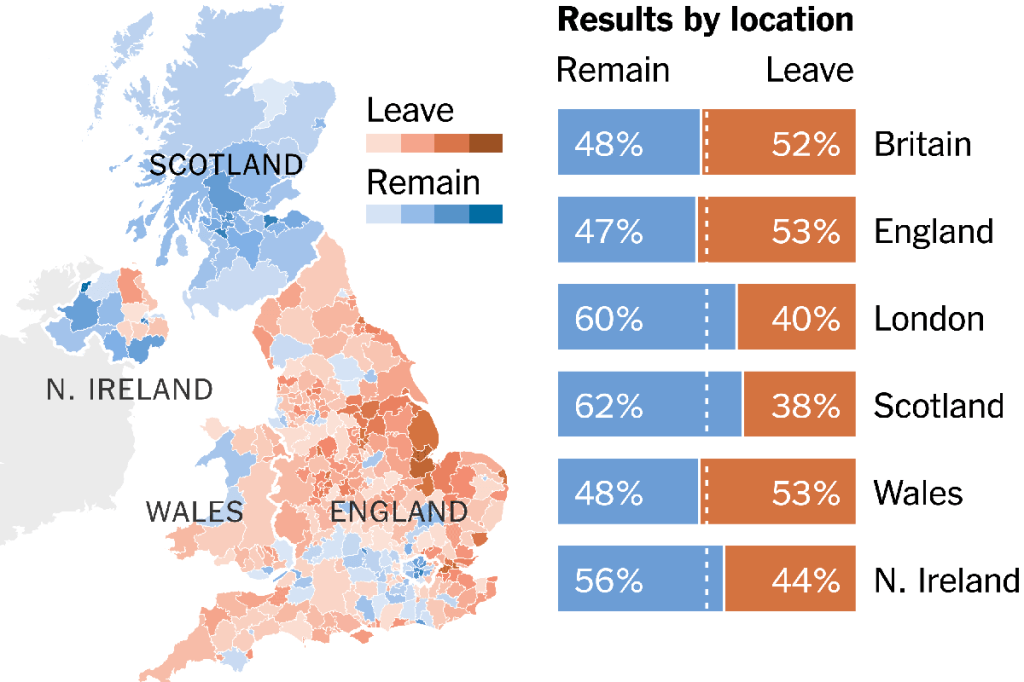
The main drivers of Brexit were England (outside London and the South), and Wales (source)
The Brexit Referendum is one of the most important political earthquakes of the Twenty First Century so far, and in the author’s opinion fatally weakens the European Union and the United Kingdom, as we are likely to see over the next decade.
Brexit was a source of mirth to the author as a devolutionist who is suspicious of Political Unions in general, in realising that the biggest supporters of the British Union were against the European Union, and the biggest supporters of the European Union were most hostile to the British Union!

In the end, Britain voted narrowly to exit the European Union after nearly half a Century, to take back powers and laws from the Brussels Commission back to the Parliament of Westminster, for Britain to run more of its economy, negotiate its own trade deals, and compete more flexibly and effectively outside the EU’s trade union monopoly and the mad bureaucrats of Brussels.
Alas, the fatal flaw of this independent outlook since 2016, was that neither David Cameron or the Conservative Party that allowed the referendum, nor Westminster politicians and Whitehall civil servants, nor London’s media and press (the BBC particularly), ever expected the majority of Britain to vote leave, therefore there was no desire or will in the British Establishment and no plan to grasp the independence nettle and take back control of their own Country, by severing the Acts and Laws of the Continent.
The result is that today, over eight years since Brexit, we have done nothing with the gift of British Independence, still subservient to most of the nonsensical laws and regulations on the Continent, still without control over our fisheries industry, and still running massive trade deficits of now over £100 Billion per annum, in other words Britain is purchasing over £100 Billion of European goods (mostly from Germany) more than the sell to us. We are exporting our industries and companies and jobs to German industrialists and French farmers, while Britain exports the Pound and our National Debt via our FIRE (Finance, Insurance and Real Estate) sector to pay for this catastrophic subsidy, and only running a balance of trade with Europe would return over £100 billion a year worth of industries and jobs back to Britain!!!

According to House of Commons statistics on trade for 2023, Britain has run a trade surplus of £75 billion with the rest of the world while running a trade deficit of £109 Billion with the European Union. This is the reason that what is left of our industries is disappearing, making us increasingly dependent on imports from foreign countries (source)
Brexit is increasingly being recognised today as a catastrophic mistake by those who voted to remain and those who voted to leave, but this due to the political hash the Conservatives and the British Establishment have made of Leave, unsurprising upon the realisation that the British State is run by left wing liberals. The blowback for Brexit impotence for the Conservative Party was its landslide defeat in the 2024 General Election, likely leading to the collapse of the Party in the next five years as the centre and right fight over the carcass, while europhile Labour now have a simple majority in the House of Commons to slow up and sabotage Brexit further, with the same Permanent Bureaucracy scheming secretly in the shadows pulling the strings of Labour, as they did the Tories. We are headed into darker days for this Country in the next few years.
In terms of the long term decentralisation trend there is light, and we will likely look back at Brexit in the next decade or two as the beginning of the end for the European Union and the United Kingdom, and a very positive development in the author’s opinion. Europe has now lost one of its main financial contributors in Britain, increasing the burden on Germany and France as core foundation of the currency and debt union, forcing Germany to pull the plug on the European experiment sooner. It has to be remembered that the EU and Euro are extremely young and immature compared to the long established United Kingdom and Pound Sterling, therefore it is logically the EU and the Euro that will disintergrate first.

Results for the National Identity question in the 2011 Census, showing that only a few areas of London (and Northern Ireland) consider themselves British first. This important question has changed by the 2021 Census, more discussion here (source)
Within Britain, Brexit has exposed the differences between the mindset of London’s population (and media establishment) and the rest of England, and between England and the Celtic Countries, currently manifesting as strengthening movements in Scotland and Wales for further Devolution, and even independence. Not only has Brexit fatally wounded the European Union in the long run, the author is also of the opinion that Brexit will break apart the United Kingdom in the next generation.
The Present and the Reality of the British Union
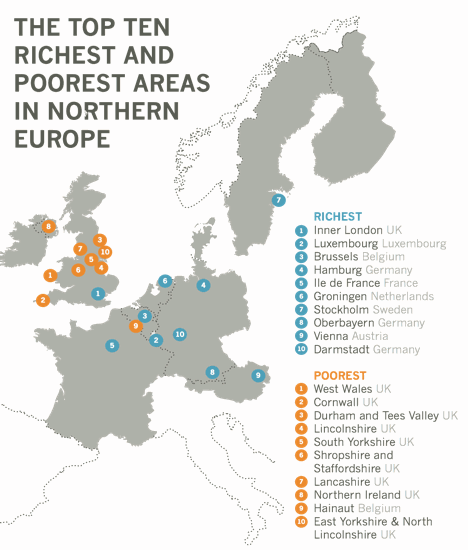
This map is from 2014, two years before Brexit, reflecting our trade deficits with Northern Europe and the debt and poverty this creates outside London’s financial centre, that benefits most from our current economy through the common currency, the Pound (source)
An important step is to get to the root of the truth of how Unions operate, who benefits and who suffers, and the State and Media work together in this realm to misinform, confuse and gaslight the British Public.
Listening to London’s media establishment in the dragon’s lair, London is the financial powerhouse and subsidiser of the rest of Britain, through Government, the Treasury, the Bank of England and the City of London’s financial sector.
Further, the English believe they suffer because they subsidise the economies of Scotland, Wales and Northern Ireland via local government, as public sector spending in the Celtic Countries is higher per capita and in GDP, which is true.
The Celtic Countries likewise complain they suffer at the hands of the English because they own the Treasury in London, and calculations like the Barnett Formula that decide the subsidies doled out to Scotland, Wales and Northern Ireland in exchange for their taxes.
Everyone is squabbling amongst each other, while the nature and reality of our monetary and currency union centrally issued out of London, gets lost in the noise. The reality is that London receives the ultimate subsidy out of this system via the Cantillon Effect, with those closest to the inflationary credit creation apparatus receiving the money first, and at the original purchasing power. As this money circulates outwards from the centre to the rest of the country, to the later receivers and as its purchasing power is diminished. This reflects the relative over-abundance of money (and the mirage of wealth) in London and England’s South East, and relative shortages of money and poverty in the rest of England, Scotland and Wales, depicted in in the graphics below.
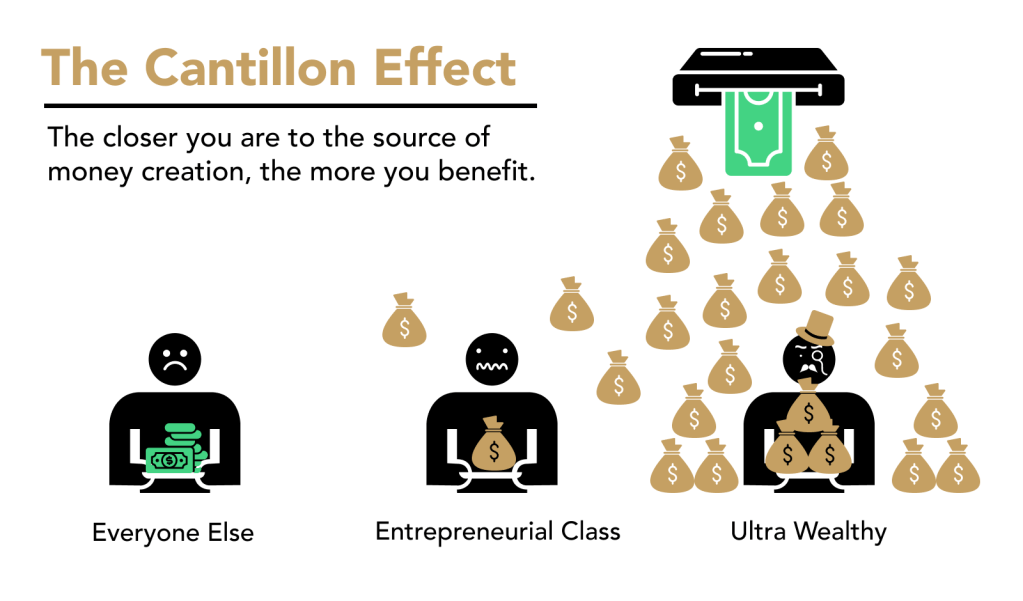
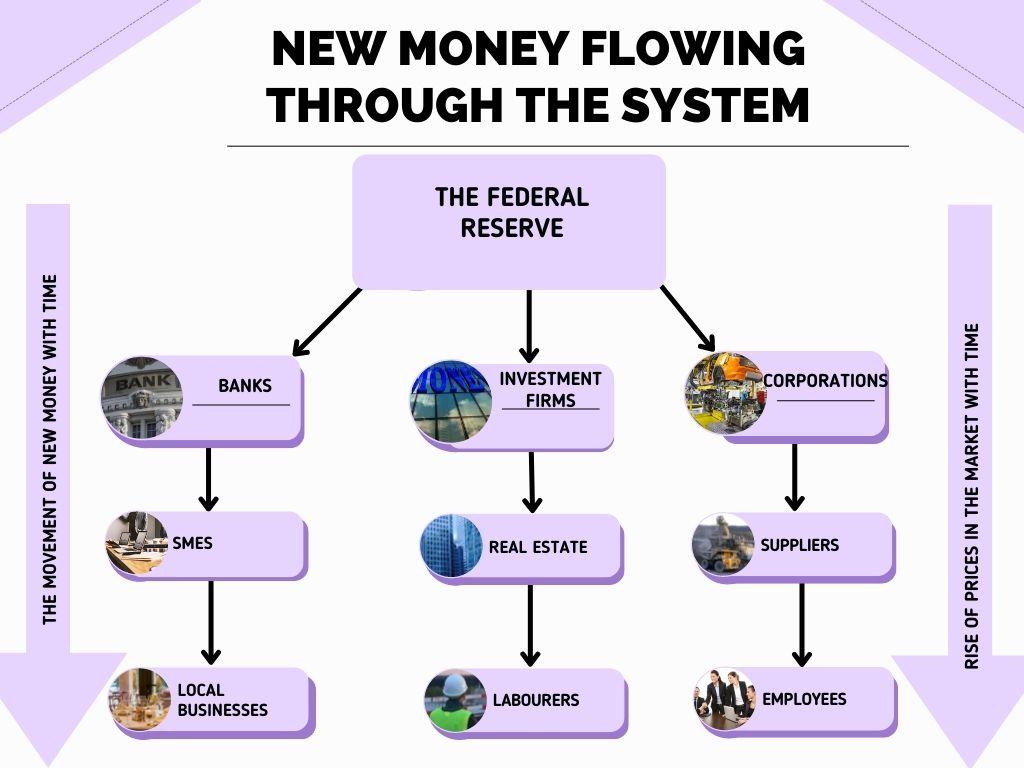
Two graphics that describe how money flows from the centre towards the peripheries, and losing its purchasing power on the journey. The Cantillon Effect also explains how London is the richest area in Northern Europe, while eight of the poorest areas are within the same Union (source, source)
Once the people of Wales, Scotland and the North and Midlands of England wake up to how the Pound and our present monetary union operates, it is possible to unify and turn their gaze towards the City of London banks, and the centre, the Bank of England. Unfortunately this is not likely to happen anytime soon, but the persistent inflation and debasement of the Pound will guarantee more debts out of London’s Treasury and more poverty in the rest of Britain, driving more inflation and taxation, and forcing more of the population to seek monetary solutions outside the Pound’s debt matrix, and into competing external currencies as the Digital Age proceeds.
End of Part One
Bitcoin donations gratefully accepted:
bc1q49a3y9anq3a2pjqvq3gm8wj8aqqld3pnva9phwna2ftdar73mf3qak275j

Gadael sylw
Ysgrifennwch sylw…

 Welsh Money Blog